


But what if I told you there's a way to walk away with profit even when selections fail? Not through some mystical handicapping power or insider information, but through intelligent bet structuring. That's where betting systems come into play, and honestly, it's one of the most misunderstood concepts in sports gambling.
Here's the thing when most people hear "bet system," they're actually thinking about two completely different animals. There's system betting, which is about how you combine your selections (think Trixies, Yankees, all those fancy names bookmakers throw around). Then there's staking systems, the mathematical progressions that tell you how much to risk (Martingale, Fibonacci, Kelly Criterion). Both get lumped under the same term, which creates massive confusion.
This guide cuts through that confusion. You'll learn exactly what betting systems are, how they actually work in practice, and more importantly, which ones might suit your style and bankroll. I'm not going to promise you riches anyone selling a "guaranteed winning system" is lying through their teeth. The house edge exists, and no amount of clever staking will erase it. But what these systems can do is bring structure, discipline, and proper bankroll management to your betting. They're tools, not magic wands.
We'll cover everything from combination bets that protect your stake to progression strategies that scale your risk. You'll see real examples, understand the mathematics (don't worry, I'll keep it digestible), and learn why some systems that sound brilliant on paper collapse under the weight of reality. By the end, you'll know enough to make informed decisions about which approach fits your goals.
What is a Bet System?
Let's start by clearing up the terminology mess. The phrase "bet system" means different things depending on who's talking, and that ambiguity causes endless confusion for bettors trying to learn this stuff.
In one corner, you've got system betting this refers to combination wagers where multiple selections are structured into smaller, interconnected bets. Patent, Trixie, Yankee, Lucky 15... these names sound like racehorses or British desserts, but they're actually bet types that spread your risk across multiple outcomes. The beauty here is partial insurance. Unlike an accumulator where everything needs to win, system bets let you collect returns even when some selections lose. You're essentially buying safety at the cost of a higher total stake.
In the other corner sit staking systems these are mathematical frameworks that dictate how much money you should risk on each individual bet. These systems don't pick winners for you or tell you what to bet on. Instead, they answer the question: given my current bankroll and the odds I'm facing, what's the optimal stake? Martingale doubles your bet after losses. Fibonacci follows a famous number sequence. The Kelly Criterion uses actual probability calculations to find mathematically optimal bet sizes. These approaches manage your money, not your selections.
The confusion happens because both get called "betting systems," yet they serve fundamentally different purposes. One is about diversifying your selections for protection. The other is about controlling your stake size for bankroll survival. Professionals often use both simultaneously they might place a Yankee bet while applying Kelly Criterion principles to determine stake sizes for each leg. That's advanced territory, though.
So why do betting systems exist at all? Because raw gambling without structure is financial suicide. Human beings are terrible at making rational decisions under uncertainty, especially when emotions run high. We chase losses, we bet too much after wins, we convince ourselves that patterns exist in randomness. Systems impose discipline. They remove emotion from the equation by following predetermined rules.
That said, let's be ruthlessly honest about something crucial: no betting system can overcome the fundamental mathematics of sports gambling. Bookmakers build their edge into the odds through something called vig, juice, or overround. That edge means if you bet randomly, you'll lose money over time. Period. A system can't magically erase that disadvantage.
What systems can do is help you manage variance the natural ups and downs of gambling outcomes. They can extend your bankroll's lifespan, helping you avoid the catastrophic losses that come from poor money management. They can keep you in the game long enough for your edge (if you have one through superior analysis) to actually manifest. Think of betting systems like budgeting for regular finances. A budget doesn't make you rich, but it stops you from going broke impulsively.
The most dangerous myth about betting systems is that they're some secret weapon for beating bookmakers. You'll find countless websites selling "guaranteed winning systems" or "proven strategies that bookies don't want you to know." This is nonsense. If someone genuinely had a foolproof system, they'd be using it to print money, not selling it to strangers online for $97. The people making money from "winning systems" are the ones selling them, not using them.
Another critical point: betting systems work best when you actually have an edge in your selections. If you're skilled at identifying value bets situations where the true probability of an outcome is higher than the bookmaker's odds suggest then a proper system helps you exploit that edge efficiently. But if you're just betting randomly or following hunches, no system in the world will save you. You can't polish a turd, as they say. Bad selections with perfect money management still lose money, just more slowly.
System Betting vs. Staking Strategies: Understanding the Difference
Right, let's nail down this distinction properly because it trips up even experienced bettors. These two concepts system betting and staking strategies are fundamentally different beasts, yet the terminology overlap makes people treat them as interchangeable. They're not.
System betting is about the WHAT. What am I betting on? How are my selections arranged? If you pick four football matches and combine them into various doubles, trebles, and a four-fold accumulator, that's a system bet (specifically a Yankee). You're diversifying your selections across multiple smaller bets rather than putting everything into one do-or-die accumulator. The system bet answers the structural question of how your picks interact with each other.
Staking strategies, by contrast, answer the HOW MUCH. How much of my bankroll should I risk? Should I bet more after winning or losing? These are money management frameworks. When you decide to double your stake after a loss (Martingale) or bet a fixed percentage of your current bankroll (flat betting), you're employing a staking strategy. The bets themselves could be singles, accumulators, or system bets the staking strategy doesn't care. It just governs stake sizing.
Here's a concrete example to hammer this home. Imagine you've got £500 in your betting account. You fancy three Premier League matches this weekend: Arsenal to win, Liverpool to win, and Manchester City to win. You could approach this several ways.
Approach one: Create a Patent system bet. That's three singles, three doubles, and one treble seven total bets. This is system betting. Now, how much do you stake per bet? You could use flat betting (same amount on each), risking 2% of your bankroll per bet, which is £10 per line for a total outlay of £70. The Patent structure handles your selections, while flat betting manages your stake size. Two different systems working together.
Approach two: Just put all three in an accumulator and use Martingale staking. If this accumulator loses, you'll double your stake on the next accumulator you place. Here, you're using traditional accumulator betting (not a system bet) combined with a progressive staking strategy (Martingale). Different tools, same selections.
The reason this matters is that people often conflate the two and make terrible decisions as a result. Someone might say, "I'm using the Martingale system," and think that somehow protects their selections. It doesn't. Martingale just means you're doubling stakes after losses you could be making absolutely horrific betting choices and Martingale won't save you. Similarly, placing a clever Trixie bet doesn't eliminate the need for proper stake management. You could blow your entire bankroll on a single Trixie if you're not controlling your stake sizes.
Both system betting and staking strategies exist to manage risk, but they attack the problem from different angles. System bets distribute your risk across multiple outcomes, creating built-in insurance against partial failure. If you have four selections in a Yankee and three win, you still collect returns from the successful combinations. Staking strategies, meanwhile, protect your overall bankroll by ensuring you never bet so much that one bad run destroys you.
Can you combine them? Absolutely, and smart bettors do exactly that. You might place a Lucky 15 (system betting) while applying Kelly Criterion (staking strategy) to determine the optimal stake per line. This creates multiple layers of risk management. But you need to understand each layer independently before stacking them together, otherwise you're just adding complexity without understanding.
One final thought on this: neither system betting nor staking strategies can turn bad bets into good ones. If you're consistently picking losers or betting into negative expected value situations, no amount of structural cleverness will rescue you. These tools are force multipliers. They amplify your edge if you have one, or slow your losses if you don't. They're not magic bullets.
Betting systems · analysis
Betting Systems Simulator
Compare different staking systems (Flat, Martingale, Fibonacci, Kelly) and system bets (accumulators, Trixies, Yankees). See how they perform over a sequence of bets and understand the impact on your bankroll.
Flat is the benchmark — consistent and predictable. Martingale doubles after losses (high risk). Fibonacci follows the Fibonacci sequence (1,1,2,3,5,8...). Kelly calculates the optimal stake based on your edge. The simulation runs thousands of times for reliability.
Trixie = 3 doubles + 1 treble (4 bets). Yankee = 6 doubles + 4 trebles + 1 fourfold (11 bets). Patent = 3 singles + 3 doubles + 1 treble (7 bets). System bets offer more coverage but at higher cost — they work best when you have multiple value selections.
For informational purposes only — simulations are statistical models. No system guarantees profits. Gambling can be addictive. Play responsibly. 18+.
How System Betting Works (Combination Bets)
System betting gets its name from the systematic way it covers different combinations of your selections. Instead of lumping everything into one fragile accumulator, you're creating a network of smaller bets that offer multiple routes to profit. Let me walk you through the mechanics because this is where theory meets practice.

Interconnected network of betting combinations showing how system bets create multiple paths to profit
The fundamental concept is straightforward: take multiple selections and automatically create every possible combination of doubles, trebles, four-folds, and so on. Each combination is an individual bet with its own stake. So if you place a system bet, you're actually placing many bets simultaneously. The total cost is your unit stake multiplied by the number of combinations in your chosen system.
Let's use a three-selection example because it's simple enough to track. Say you fancy three tennis matches: Djokovic to win at 1.50, Alcaraz to win at 1.80, and Sinner to win at 2.00. You've got £10 burning a hole in your pocket. You could whack it all on a treble (accumulator) for potential returns of £54. But if any one player loses, you get nothing. That's the accumulator gamble everything or nothing.
Now consider a Trixie instead. This system takes your three selections and creates three doubles plus one treble four bets total. Your £10 doesn't go on one bet anymore. Instead, you're staking £2.50 per line (£10 divided by four bets). Here's what you've got:
Double one combines Djokovic and Alcaraz (1.50 × 1.80 = 2.70 odds). Double two pairs Djokovic and Sinner (1.50 × 2.00 = 3.00). Double three matches Alcaraz and Sinner (1.80 × 2.00 = 3.60). Then there's the treble covering all three (1.50 × 1.80 × 2.00 = 5.40). If all three players win, you collect on all four bets. But here's the crucial part: if only two win, you still profit from one double. That's the insurance policy you're buying.
The mathematics behind combination betting involves permutations, but you don't need to be a mathematician to use them. Bookmakers' software handles the calculations automatically. You just need to understand what you're actually betting on when you tick that "Trixie" or "Yankee" box.
Different system bets exist for different numbers of selections, each with its own risk-reward profile. A Patent adds singles to a Trixie, giving you seven bets total from three selections. This means even if only one selection wins, you get something back from that single. It's more expensive (seven stakes instead of four) but offers maximum coverage. Beginners often gravitate toward Patents because that safety net feels comforting.
Step up to four selections and you enter Yankee territory 11 bets comprising six doubles, four trebles, and one four-fold accumulator. No singles here, so you need at least two winners to see any return. The advantage is you can still profit nicely with just two or three winners, depending on the odds. Yankees work brilliantly for horse racing when you've identified multiple decent-value selections across a day's card.
Add singles to a Yankee and you've got a Lucky 15 15 bets total. Many bookmakers offer bonuses on Lucky 15s, like double odds if you've got just one winner, or consolation bonuses for certain outcomes. These promotions make Lucky 15s particularly attractive for Saturday football accumulators or Cheltenham racing festivals. The marketing name "Lucky" isn't accidental bookmakers love them because the high stake count (15 times your unit) means big handle, but the bonuses create customer loyalty.
Then things get serious. A Heinz covers six selections with 57 bets. A Super Heinz does seven selections across 120 bets. The Goliath, granddaddy of system bets, takes eight selections and explodes them into 247 individual wagers. You need substantial bankroll for these monsters. Even at £1 per line, a Goliath costs £247. But the trade-off is incredible coverage. You could have three or four losers and still walk away in profit if the winners come in at decent odds.
The key strategic insight with system betting is understanding the break-even point for each type. How many winners do you need, at what minimum odds, to profit after covering your total stake? This requires either experience or a calculator. Most online bookmakers show potential returns for various winning scenarios before you confirm your bet, which helps tremendously.
System bets shine brightest when you're dealing with medium-to-high odds selections where you're confident but not certain. If you're betting heavy favorites at 1.20 or 1.30, system betting gets expensive relative to potential returns because you need multiple winners just to cover your stake. Conversely, if you're slinging longshots at 10.00 or 15.00, you might be better off with straight singles or small accumulators because system bet stake costs balloon quickly.
One crucial point that trips people up: each line in your system bet is settled independently based on the final odds when that specific combination is calculated. This means if you've got related outcomes (like "Liverpool to win" and "Over 2.5 goals in Liverpool match"), bookmakers might restrict odds or refuse the bet because the outcomes are correlated. System bets work best with independent selections across different matches or events.
The psychological benefit of system betting shouldn't be underestimated either. There's something deeply satisfying about having one or two losers but still banking profit from your winning combinations. It removes that gut-wrenching "one goal away" feeling that plagues accumulator betting. You're trading the massive jackpot potential of accumulators for the steadier, more frequent returns of system betting. It's the tortoise versus hare approach to sports gambling.
Popular Staking Systems for Sports Betting
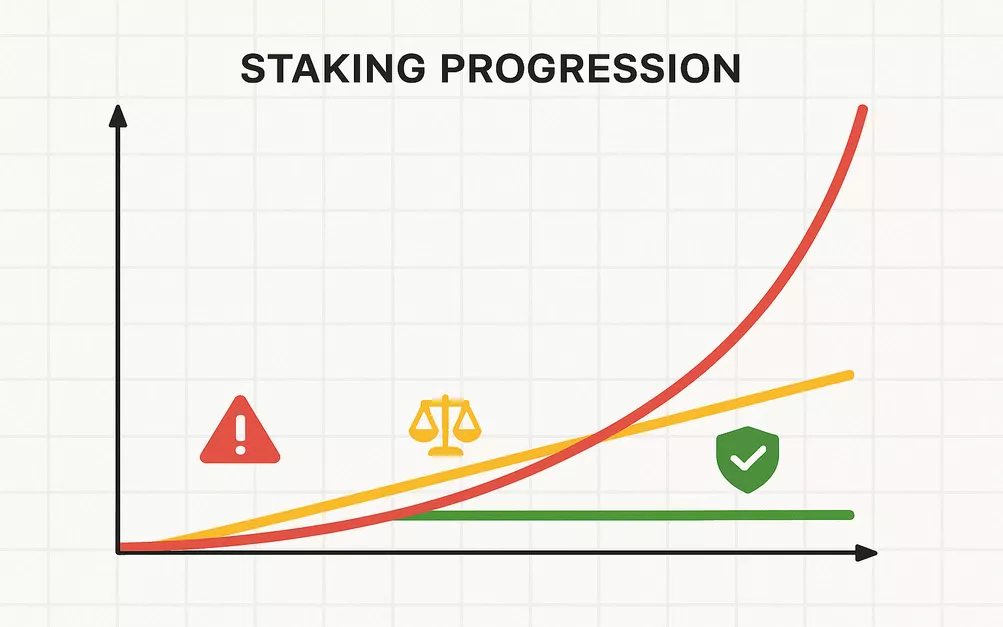
Visual comparison of staking strategies showing risk profiles from aggressive to conservative approaches
Now we dive into the other half of the equation how to actually manage your money when betting. This is where things get mathematical, sometimes uncomfortably so, but stick with me because understanding these systems could save your bankroll from extinction.
Staking systems fall into three broad categories. Negative progressions increase stakes after losses, attempting to recover deficits. Positive progressions increase after wins, trying to maximize hot streaks. Fixed systems keep stakes constant, prioritizing stability over potential gains. Each philosophy attracts different personality types and bankroll situations.
Negative Progression Systems
These are the controversial ones, the systems that promise loss recovery but can devastate bankrolls if you're unprepared for their demands.
The Martingale System is the most famous and most dangerous. The logic seems bulletproof: double your bet after every loss so that when you eventually win, you'll recover all previous losses plus a profit equal to your original stake. In theory, as long as you keep doubling, you must eventually win and come out ahead.
Here's a real-world example. You start betting £10 on an even-money selection (like a -110 NFL spread). You lose. Next bet: £20. Lose again. Next: £40. Then £80, £160, £320, £640... notice how quickly this escalates? After just seven consecutive losses which happens more often than you'd think you're staking £1,280 to win back your original £10. Most bettors don't have the bankroll to sustain this progression, and even if they did, bookmakers impose maximum bet limits that would stop the sequence anyway.
The Martingale seduces people because it works brilliantly right up until the moment it catastrophically fails. You can go weeks or even months showing steady small profits, feeling like you've cracked the code. Then one brutal losing streak vaporizes everything. I've seen bettors lose five figures chasing £20 profits with Martingale. It's financial Russian roulette.
The system has an even darker flaw beyond bankroll requirements: it violates basic probability. Each bet is an independent event. The fact that you've lost seven times in a row doesn't make the eighth bet more likely to win. The odds don't care about your previous results. You're not "due" for a win that's gambler's fallacy talking.
The D'Alembert System offers a gentler slope. Instead of doubling, you increase stakes by one unit after a loss and decrease by one unit after a win. If your unit is £10, a loss means your next bet is £20, then £30, and so on. A win drops you back down. This creates a more gradual progression that's easier on bankrolls.
The theory behind D'Alembert assumes eventual equilibrium you'll win about as many bets as you lose over time. If true, the system should profit because you're betting more on winners (higher up the progression) than on losers (lower down). The problem is that assumption of equilibrium. Sports betting isn't a coin flip. You're playing against vig, which skews results against you. Still, D'Alembert is substantially safer than Martingale for those insistent on using negative progression.
The Fibonacci System applies the famous mathematical sequence (1, 1, 2, 3, 5, 8, 13, 21, 34...) to stake sizing. Each number is the sum of the previous two. You move one step forward in the sequence after a loss, two steps backward after a win. So if you're at the sixth number (8 units) and you win, you drop back to the fourth number (3 units).
This system increases stakes slower than Martingale but faster than D'Alembert. It requires meticulous record-keeping because you need to track your position in the sequence constantly. A single miscalculation throws everything off. Fibonacci appeals to bettors who want the loss-recovery concept without Martingale's terrifying stake escalation. The sequence's mathematical elegance makes it feel more "scientific," though in practice it's still chasing losses, just with a prettier pattern.
The Labouchere System gets complicated fast. You start by writing down a sequence of numbers that add up to your desired profit. Say you want £30 profit, so you write 5-5-5-5-5-5. Your first bet is the sum of the first and last numbers (5+5=£10). If you win, cross off those numbers. If you lose, add your stake to the end of the sequence, which becomes 5-5-5-5-5-5-10. Continue until all numbers are crossed off or you hit your stop-loss.
Labouchere gives you a target-oriented framework rather than just mindlessly chasing losses. Some bettors find this psychologically helpful. The downside is complexity maintaining the sequence requires focus and the same fundamental problem all negative progressions face: you're betting more when losing, which compounds poor decision-making and can exhaust your bankroll during bad runs.
Positive Progression Systems
These flip the script: increase stakes when winning, not losing. The appeal is obvious you're pressing your advantage during hot streaks while keeping stakes low during cold ones.
The Paroli System tells you to double your stake after each win, up to a predetermined cap (usually three consecutive wins), then reset to your base stake. If you start with £10 and win three times, you've bet £10, £20, then £40, collecting profits at each stage before dropping back to £10.
The beauty of Paroli is limited downside. Losing streaks only cost your base stake per bet. The risk is that winning streaks often end before you hit your target multiplier. You'll have plenty of sequences where you win once, double your stake, then lose, leaving you essentially break-even for two bets. But when you do catch a run, the returns can be sweet.
The 1-3-2-6 System follows a fixed progression sequence: bet 1 unit, then 3, then 2, then 6, resetting after a loss or completing the sequence. If your unit is £10 and you win all four stages, you've risked a total of £120 across the progression while potentially building substantial returns. Any loss sends you back to the beginning.
This system is rigid, which some bettors love (no decisions, just follow the sequence) and others hate (no flexibility). It works best on relatively even-odds bets where you've got close to 50% chance of winning each stage.
Fixed Systems
These are the boring, sensible systems that professionals actually use.
Flat Betting means wagering the same amount on every bet, regardless of recent results, current bankroll, or confidence level. You decide on a unit size (typically 1-5% of your total bankroll) and never deviate. If you've got £1,000 and choose 2%, every single bet is £20. Won five in a row? Still £20. Lost seven straight? Still £20.
The psychological discipline required for flat betting is enormous because it fights against human nature. We want to bet more when we're winning (we're hot!) and either bet more to recover losses (I can't quit now!) or stop betting entirely (I'm cursed!). Flat betting says no to all that emotion. Just grind, track your results, and trust the mathematics of large sample sizes.
Why do pros favor flat betting? Because over hundreds or thousands of bets, emotional stake adjustments introduce variance that destroys edge. If you genuinely have a skill for finding value bets, flat betting lets that edge manifest cleanly without interference from money management. You're isolating your betting ability as the variable. If you win 54% of your bets at average odds, you'll profit. The stake size stays constant, letting you accurately measure performance.
The Unit System introduces slight flexibility. Instead of betting the same amount every time, you assign confidence ratings to bets (usually 1-5 units or 1-10 units) and bet accordingly. A lock gets 5 units, a speculative punt gets 1 unit. Your unit size is still a fixed percentage of bankroll, say 1%, so units scale with your bankroll growth or decline.
This system acknowledges that not all bets are created equal. Sometimes you've got premium information or spot glaring value. The unit system lets you capitalize on those opportunities while maintaining overall discipline. The danger is overconfidence too many bettors convince themselves that mediocre picks are "5-unit plays," negating the entire point of the system.
The Kelly Criterion deserves special mention as the mathematically optimal staking strategy, though it's complex enough to warrant its own detailed discussion. The formula is f = (bp-q)/b, where f is the fraction of bankroll to bet, b is the decimal odds minus 1, p is your probability of winning, and q is the probability of losing (1-p).
Kelly tells you exactly how much to bet based on your edge the difference between the true probability of an outcome and the odds offered. If you estimate a team has a 55% chance of winning but the odds imply only 50%, Kelly calculates optimal stake size to maximize long-term bankroll growth. The catch: you need accurate probability estimates. Most bettors overestimate their ability to assess true probabilities, leading to overbetting via Kelly.
Even professional Kelly users typically bet "fractional Kelly" (quarter or half Kelly) because full Kelly creates wild variance. A bad run can see your bankroll swing 30-40% even when you're betting correctly. Fractional Kelly smooths this out, sacrificing some growth potential for psychological sanity and bankroll preservation.
The hard truth about staking systems: none of them can create an edge where none exists. If you're betting randomly or into negative EV spots, a staking system merely changes how quickly you lose money. Martingale makes you lose catastrophically but potentially over a long period. Flat betting makes you lose slowly and steadily. The rate changes, not the direction.
Staking systems work when layered on top of an existing edge. If you've developed skill at finding value bets through superior analysis, tactical knowledge, or faster information, then proper stake management amplifies that edge efficiently while protecting against variance. The staking system is the engine management system for your betting engine it can't make a broken engine run, but it makes a good engine run optimally.
Choosing the Right Bet System for Your Goals
The question isn't which system is objectively "best" it's which one matches your specific situation, risk tolerance, and betting style. A system that works brilliantly for a professional with a £50,000 bankroll might obliterate a casual bettor starting with £200.

Strategic bankroll management visualization showing percentage-based stake allocation and risk protection
Start by assessing your bankroll realistically. Not what you wish you had, but what you can genuinely afford to lose completely without affecting your life. This sounds grim, but gambling requires you to be honest about worst-case scenarios. If losing your betting bankroll would mean missing rent, you shouldn't be gambling at all, and certainly not experimenting with aggressive systems.
For small bankrolls (under £500), conservative approaches are mandatory. Flat betting at 1-2% per bet combined with simple system bets like Patents or Lucky 15s provides reasonable protection. You can't withstand big swings, so you need systems that extend your playing time and give you multiple shots at success. Avoid Martingale and other negative progressions entirely you'll blow up within weeks.
Medium bankrolls (£500-£5,000) offer more flexibility. You can experiment with unit-based confidence systems, perhaps venturing into D'Alembert or Fibonacci progressions if you're curious, though I'd still recommend sticking with flat betting fundamentals. This bankroll range lets you place proper system bets like Yankees or Heinzs across multiple selections without the stake cost destroying you.
Large bankrolls (£5,000+) can absorb variance and explore advanced strategies. This is where Kelly Criterion becomes viable, though start with fractional Kelly until you're comfortable with the concept. You can mix complex system bets with sophisticated staking strategies, creating layered risk management.
Your risk appetite matters enormously. Some people sleep fine after losing £100, others stress over £10. Be honest with yourself. If losing makes you miserable or leads to chasing behavior, you need conservative systems. Flat betting, Patents, simple singles boring but effective. If you've got ice in your veins and can emotionally handle swings, you might tolerate positive progressions or larger system bets.
Sport selection influences system choice too. Football lends itself to system betting beautifully because weekend slates offer multiple matches at various odds. You can build Yankees or Lucky 15s covering different leagues. Horse racing practically invented system betting punters have been running Patents and Lucky 15s on Saturday cards for decades. Tennis, with its frequent matches and two-outcome simplicity, works well for progression systems on match winners.
American sports like NFL or NBA favor different approaches. NFL's once-weekly schedule and high vig (-110 standard) make flat betting at 1-2% units the professional standard. You're grinding value picks, not building system bets. NBA's nightly action allows for more frequent betting and potential daily system bets on multiple games, though again, flat staking predominates among serious bettors.
Time commitment factors in. System betting requires research for multiple selections. If you're only casually betting one or two matches per week, complex system bets are overkill. Stick with singles or small accumulators. If you're degenerately following eight different leagues and betting daily, system bets help structure that action intelligibly.
Combining system betting with staking strategies is where sophistication emerges. You might place a Yankee (system betting) while applying Kelly Criterion (staking strategy) to determine your unit stake per line. This creates multi-layered risk management. But understand each layer individually before stacking them together. Complexity without understanding is just confusion.
One framework I've found useful: start simple, prove competence, then add complexity incrementally. Begin with flat betting and singles until you can demonstrate you're not hemorrhaging money. Then introduce simple system bets like Trixies or Patents while maintaining flat stakes. If you're still showing discipline and tracking results properly after six months, consider experimenting with unit-based confidence systems or fractional Kelly. Graduate to complex system bets (Heinzs, Goliaths) only when you've got the bankroll and experience to handle them.
Common Mistakes and How to Avoid Them

Critical betting mistakes to avoid - warning signs and common pitfalls in sports betting systems
Even bettors who understand systems intellectually often sabotage themselves through predictable errors. Here are the killers I've seen repeatedly.
Chasing losses with progression systems. This is the number one bankroll destroyer. You're down £200, feeling frustrated, so you jump into Martingale thinking you'll quickly recover everything. The progression demands bigger and bigger stakes while your judgment deteriorates under pressure. By the time you're staking £500 to win back £200, you're in pure panic mode. Solution: set hard stop-losses before you start betting. If you hit that number, you walk away for the day. No exceptions, no negotiation.
Using systems without testing them. Someone reads about Fibonacci online, thinks it sounds clever, and immediately starts betting real money without any paper trading or small-stake testing. They don't actually understand how the progression works during long losing runs. Inevitable disaster follows. Solution: test any new system with tiny stakes (50p per bet) or paper trades for at least 50 bets. Track everything in a spreadsheet. See how it actually performs versus your expectations. Only then commit serious money.
Ignoring bankroll management fundamentals. This usually manifests as betting way too high relative to total funds. You've got £500 total but you're placing £50 bets because "these picks are solid." One bad weekend and you're broke. No system can save you from stakes that are disproportionate to bankroll. Solution: religiously follow the 1-5% rule. Your maximum single bet should never exceed 5% of total bankroll, and 1-2% is safer for most bettors.
Believing systems guarantee profits. The gambler's fallacy manifests here. People convince themselves that because Martingale "must eventually win" or because their system has worked for three weeks, profits are certain. They're not. Variance exists. The house edge exists. No system eliminates either. Solution: maintain realistic expectations. View systems as risk management tools, not profit guarantees. Track your actual results ruthlessly and honestly.
Not tracking performance. Many bettors just... bet. They don't record stakes, odds, results, profit/loss, or anything else. They're flying blind, with no idea if they're actually winning or losing over time. Memories are unreliable; you remember big wins and forget small losses. Without data, you can't identify what's working. Solution: use a spreadsheet or app to log every single bet. Track date, selection, stake, odds, result, profit/loss. Review monthly. If the numbers look bad, change something.
System hopping. This one frustrates me. A bettor uses flat betting for two weeks, has a bad run, switches to Fibonacci for a week, doesn't like those results, tries Martingale next, and on and on. They never give any system enough time to demonstrate its actual properties. Solution: commit to a system for at least 100 bets. That's the minimum sample size to see meaningful patterns. Variance makes short-term results nearly meaningless.
The overarching mistake is treating systems as magic rather than tools. They're frameworks for decision-making, not alchemy that turns bad bets into gold. Your underlying betting ability can you actually identify value? matters infinitely more than which staking system you choose.
Frequently Asked Questions
Do betting systems actually work?
This depends entirely on what you mean by "work." If you're asking whether betting systems can overcome the house edge and guarantee profits, the answer is no. The mathematical advantage bookmakers build into odds (through vig, overround, or juice) is permanent. No staking system or bet structure changes that fundamental reality. If you're betting randomly or into negative expected value situations, every system loses money eventually they just lose it at different rates.
However, if you're asking whether betting systems provide value as risk management and bankroll preservation tools, then yes, absolutely. Good systems impose discipline, control variance, extend your betting lifespan, and help you avoid catastrophic losses from emotional decision-making. For bettors who genuinely have an edge through superior analysis, proper systems amplify that edge by optimizing stake sizing and protecting against inevitable downswings. Think of systems like a budget for personal finance budgets don't make you rich, but they prevent you from going broke impulsively.
What's the difference between system betting and regular betting?
System betting refers to combination wagers (Trixies, Yankees, Patents, Lucky 15s, etc.) that spread multiple selections across interconnected smaller bets. Instead of putting everything into one fragile accumulator where all selections must win, system bets create insurance by covering various combinations. You might have four selections, and a Yankee system bet automatically creates six doubles, four trebles, and one four-fold accumulator from those picks 11 bets total.
Regular betting typically means single bets or standard accumulators. Singles are straightforward: one selection, one stake, win or lose. Accumulators combine multiple selections into one bet where everything must win for any payout. System betting sits between these extremes, offering protection through diversification while still allowing combination upside. The trade-off is cost system bets require multiple stakes (one per combination line), making them more expensive than single accumulators, but they pay out even when some selections lose. It's financial engineering for sports gambling.
Which betting system is best for beginners?
Beginners should absolutely start with flat betting for staking strategy, combined with simple system bets like Patents or Lucky 15s for bet structure. Flat betting means wagering the same amount (1-2% of your total bankroll) on every single bet, which removes emotional decision-making and lets you focus on selection quality rather than stake management. It's boring, which is precisely why it works no temptation to chase losses or overbet during hot streaks.
For bet structure, Patents (three selections creating seven bets) and Lucky 15s (four selections creating 15 bets) offer excellent training wheels. They include singles, so even if only one selection wins, you get something back. This teaches you how combination betting works without the devastation of losing entire stakes. Many bookmakers offer bonuses on Lucky 15s (like double odds on a single winner), which provides extra value. Avoid aggressive progression systems like Martingale entirely they're seductive but dangerous, requiring large bankrolls and iron discipline that beginners simply don't have yet. Master the basics first, add complexity only after proving you can maintain discipline and track results properly for several months.
Bet Systems: Summary and How to Choose the Right Strategy for You

Path to successful betting strategy implementation through discipline, knowledge, and systematic approach
Betting systems aren't the secret weapon marketing gurus want to sell you. They won't transform you into a professional gambler overnight, and they can't erase the mathematical edge bookmakers hold. But they're not worthless either. Used intelligently, systems bring structure to chaos, impose discipline on emotion, and help you survive long enough to let genuine skill emerge.
The real work of successful betting happens before you ever implement a system it's in the research, the analysis, the hunt for value where odds don't accurately reflect probability. Systems manage what you do with that value once you've found it. They're the framework, not the foundation.
If you're serious about sports betting, start simple. Flat betting with modest stakes. Track everything obsessively. Prove to yourself you're not just gambling randomly. Then, and only then, start exploring system bets and more sophisticated staking strategies. Complexity is earned through demonstrated competence, not adopted from blog posts on day one.
Remember that betting should be entertainment with an intellectual edge, not a desperate attempt to solve financial problems. Bet what you can afford to lose. Use systems to extend your action and manage risk, not to chase fantasies of guaranteed profits. The house edge exists, variance is real, and even the best systems can't fix fundamentally poor betting decisions.
