
The Fibonacci Betting System: The Smarter Progression Strategy for Sports Betting
 Available in US
If you’ve spent any time researching betting systems, you’ve probably encountered the Martingale and recoiled in horror at its bankroll-destroying potential. Double after every loss until your stake exceeds your mortgage payment? No thanks. But here’s the thing not all progression systems are created equal, and the Fibonacci system offers something genuinely different. It’s still a progression strategy, meaning you increase stakes after losses, but it does so in a way that’s substantially less aggressive and far more sustainable.
The Fibonacci betting system borrows its structure from one of mathematics’ most elegant sequences, a pattern that appears throughout nature from spiral galaxies to sunflower seed arrangements. That natural elegance translates into a betting framework that feels somehow less reckless than its cousins. You’re still chasing losses, which any rational analysis suggests is problematic, but you’re doing it gradually rather than exponentially. It’s the difference between walking up a steep hill versus sprinting up a cliff face.
I’m not here to tell you the Fibonacci system is some magical solution that beats the house edge. It’s not. No staking system can overcome negative expectation betting. But if you’re determined to use a progression strategy and many bettors are drawn to them for psychological reasons Fibonacci is substantially safer than alternatives like Martingale or Labouchere. It gives you the structure and discipline of a system without the terrifying stake escalation that can bankrupt you in an afternoon.
What makes Fibonacci interesting is how it manages risk while maintaining the recovery mechanism that makes progressions appealing. You’re not doubling stakes blindly. You’re following a mathematical sequence that increases gradually, giving your bankroll breathing room during those inevitable losing streaks. Does it guarantee profits? Absolutely not. Does it offer a more rational approach to progression betting than most alternatives? Yeah, it actually does.
Understanding the Fibonacci Sequence
Before we dive into betting applications, let’s nail down the sequence itself because understanding the pattern is crucial to using the system properly. The Fibonacci sequence is one of mathematics’ most famous patterns, discovered (or at least popularized) by Italian mathematician Leonardo Fibonacci in the 13th century.
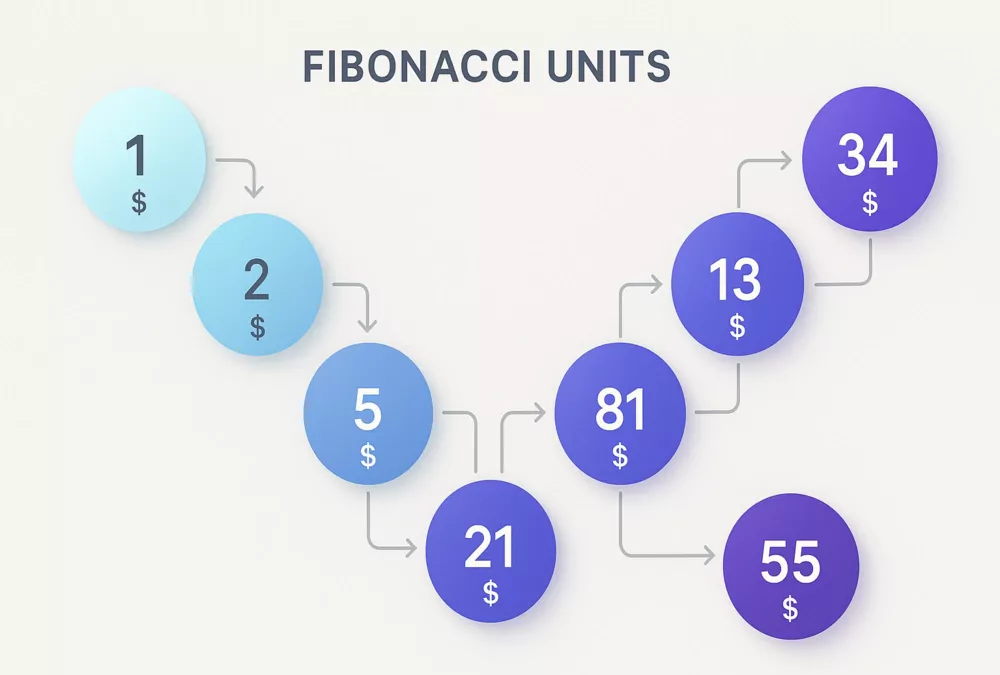
The sequence starts with zero and one, and each subsequent number is the sum of the two preceding numbers. So you get zero, one, one, two, three, five, eight, thirteen, twenty-one, thirty-four, fifty-five, eighty-nine, and so on into infinity. The pattern is deceptively simple but generates increasingly larger numbers as it progresses. That mathematical property gradual increase with accelerating growth makes it ideal for betting progressions.
Here’s what makes this sequence special beyond just being a neat mathematical curiosity. The ratio between consecutive Fibonacci numbers approaches the golden ratio (approximately 1.618) as the sequence progresses. This ratio appears throughout nature and has been used in art, architecture, and design for millennia because it’s aesthetically pleasing to human perception. Does that matter for betting? Not really, but it explains why the Fibonacci system feels somehow more “natural” than arbitrary doubling or tripling.
In betting terms, we ignore the zero at the start because you can’t bet zero dollars. Your sequence begins at one, one, two, three, five, eight, and continues from there. Each number represents units of your base stake. If your unit is ten dollars, your progression becomes ten, ten, twenty, thirty, fifty, eighty, and so forth. The stakes increase, but not as violently as Martingale’s doubling progression.
The relationship between numbers in the sequence creates the recovery mechanism. Because each number is the sum of the previous two, when you win a bet and move back two positions, you’re essentially recovering the losses from those two previous bets plus adding a small profit. This is the mathematical foundation that makes Fibonacci progressions work at least temporarily without requiring the massive stakes that Martingale demands.
Compare Fibonacci to Martingale directly and the difference becomes stark. After six consecutive losses, Martingale has you betting sixty-four times your original stake (assuming you started at one unit). Fibonacci has you betting thirteen units. That’s a massive reduction in required bankroll and risk exposure. You can survive longer losing streaks, which means you’re less likely to hit the catastrophic blow-up that ends Martingale sequences.
The sequence’s mathematical elegance also makes it easier to track and implement compared to more complex systems like Labouchere or Oscar’s Grind. You just need to remember two numbers at any given time where you are in the sequence and where you were two steps ago. No complicated calculations or written records required, though tracking your position is still recommended because mistakes in progression systems compound quickly.
Fibonacci in Sports Betting
Adapting the Fibonacci sequence to sports betting requires you to establish some foundational rules because the system doesn’t specify what kinds of bets to place or what odds to target. The sequence only governs stake sizing. Everything else is up to you, which means you need a clear framework before starting.
First decision: determine your base unit. This should be a small percentage of your total bankroll, typically between one and three percent. If you’ve got a thousand dollars set aside for betting, a one percent unit means ten dollars. Start conservative because the progression will increase stakes substantially during losing runs, and you need cushion to absorb variance.
Second decision: choose your target odds range. The Fibonacci system works best on bets with relatively even odds, ideally between 1.80 and 2.20 in decimal format (roughly -125 to +120 in American odds). This range provides enough payout to make progression recovery viable without requiring extremely high win rates. If you’re betting heavy favorites at 1.30 odds, the progression becomes less effective because each win doesn’t recover enough previous losses.
Third decision: establish your stop-loss point. How many steps into the Fibonacci sequence will you go before abandoning the progression and resetting? Most practitioners suggest stopping after reaching the eighth or tenth number in the sequence. Beyond that, stakes become uncomfortably large relative to the potential recovery. If you hit your stop-loss, you accept those losses, reset to one unit, and start fresh.
Let’s walk through a practical example using NFL point spreads. You’ve got a two-thousand dollar bankroll and decide on a one percent base unit, so ten dollars. You’re betting standard -110 odds, which require you to risk 110 to win 100 (or in your case, risk eleven dollars to win ten dollars).
Week one, game one: you bet one unit (eleven dollars to win ten) on the Rams to cover. They blow the spread in the fourth quarter. Loss. You’re down eleven dollars total.
Week one, game two: still one unit according to Fibonacci (the sequence starts one, one). Another eleven dollar stake on the Bills. They also lose. You’re down twenty-two dollars total.
Week one, game three: now you move to two units. Twenty-two dollars risked to win twenty. The Cowboys cover easily. Win. You collect forty-two dollars (your twenty-two dollar stake plus twenty dollar profit). Subtract your twenty-two dollar losses, and you’re up twenty dollars. Reset to one unit.
See how the recovery mechanism works? Even though you lost two and won one, you’re ahead because you increased your stake following the progression. The key insight is that you don’t need to win at a high rate you just need to win eventually before the progression exhausts your bankroll.
Here’s a more extended example showing the progression’s behavior during a rough stretch. You’re following the Fibonacci sequence with ten dollar base units at -110 odds. Bet one: ten units, lose, down eleven dollars. Bet two: still ten units, lose, down twenty-two dollars. Bet three: twenty dollars staked, lose, down forty-four dollars. Bet four: thirty dollars staked, lose, down seventy-seven dollars. Bet five: fifty dollars staked, win, collect ninety-five dollars. After fifty-five dollars in stakes (sum of this sequence) and forty-five dollars in previous losses, you’re down five dollars total. Not quite break-even, but substantially better than being down seventy-seven dollars.
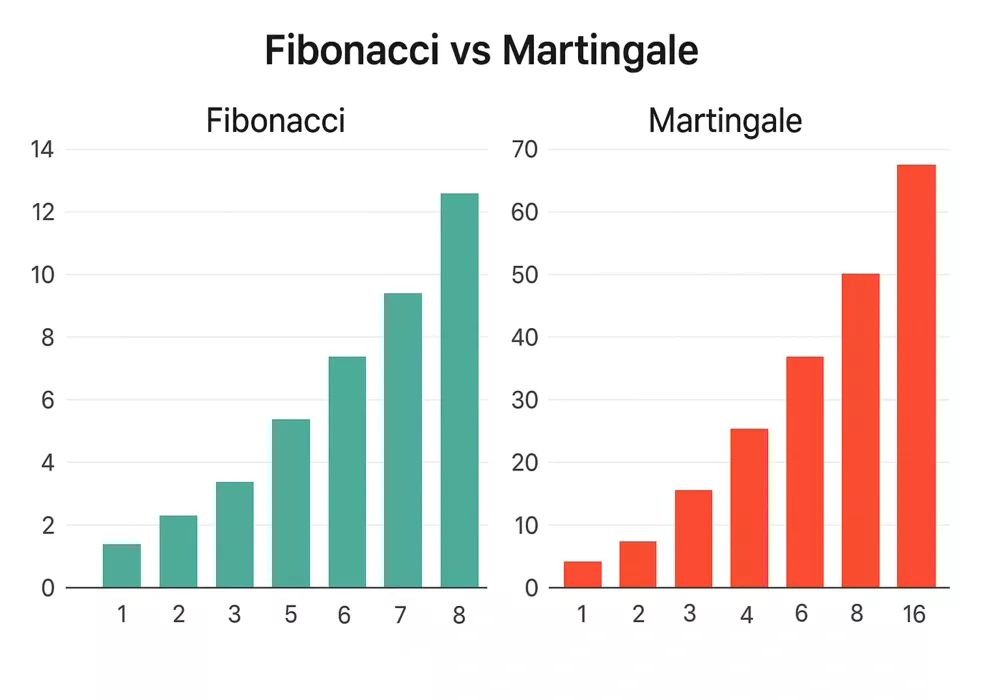
The system’s gentler slope becomes apparent when you compare total risk exposure. After eight consecutive losses in Fibonacci, you’ve risked a total of 231 units (sum of 1+1+2+3+5+8+13+21+34+55). After eight Martingale losses, you’ve risked 255 units (sum of 1+2+4+8+16+32+64+128). Not a huge difference at eight losses, but Martingale’s exponential growth means the gap widens dramatically with each additional loss. By ten losses, Martingale has you risking 1,023 units total while Fibonacci is at 376 units. That difference is your bankroll survival margin.
The Mathematics of Fibonacci Betting
Let’s dig into why the Fibonacci progression works mathematically, at least in the limited sense of recovering losses within a sequence. Understanding the mechanics helps you appreciate both the system’s elegance and its limitations.
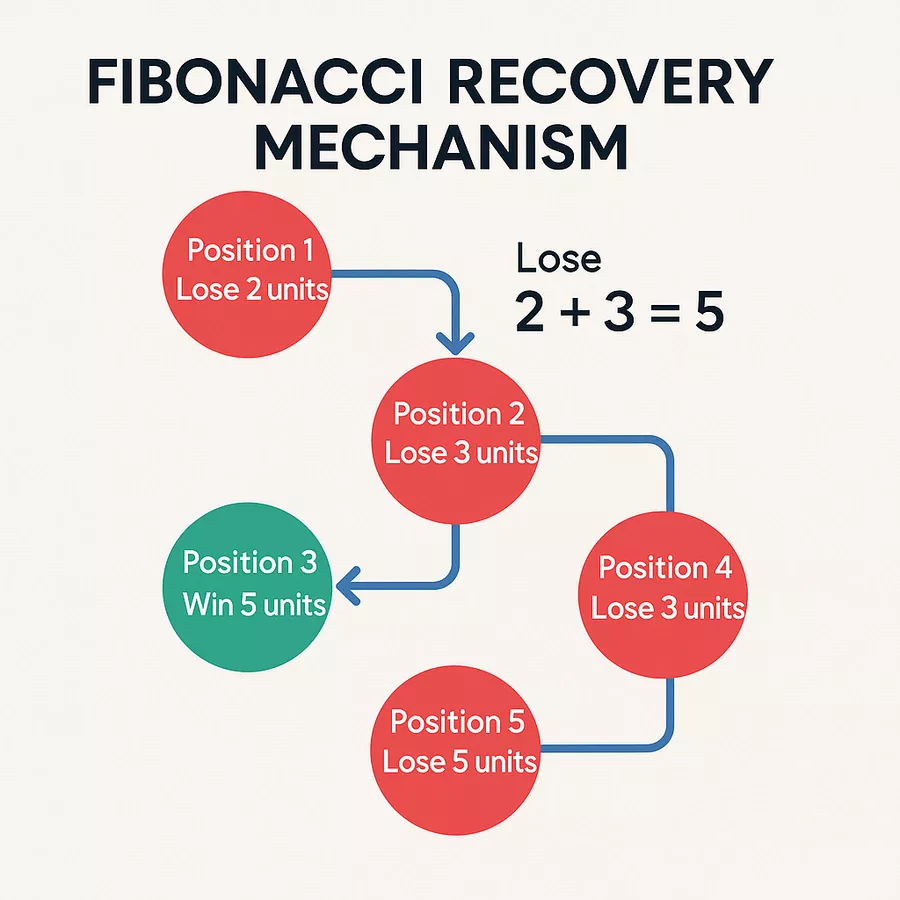
The recovery mechanism relies on the additive property of Fibonacci numbers. Each number equals the sum of the previous two, which means when you win and move back two steps, you’re positioned to recover those two previous losses plus a small profit. This relationship holds throughout the sequence regardless of where you are.
Consider position five in the sequence (five units). The two previous positions were two units and three units. So you’ve lost two units, then three units (five units total lost). When you bet five units and win, you recover those five units plus profit equal to your base unit (assuming near even-money odds). Move back two positions to two units, and you’re ahead one unit overall. The math is internally consistent.
But here’s where theory meets harsh reality. This recovery mechanism only works if several conditions hold true. You must win eventually before exhausting your bankroll. Your odds must provide sufficient payout to recover previous losses. You can’t hit external constraints like maximum bet limits. And critically, you must be betting into positive or neutral expectation or at minimum, the house edge can’t be so large that it overwhelms your progression.
That last point is where Fibonacci, like all progression systems, runs into trouble. If you’re betting -110 odds in sports betting, you’re facing roughly 4.5 percent negative expectation. Every bet you place has an expected value of negative 4.5 percent. The Fibonacci progression doesn’t change this. You’re still making negative EV bets. The progression only redistributes when those losses materialize.
Calculate expected value across an entire Fibonacci sequence and you’ll see the problem. Assume you’re betting at -110 with a fifty percent true win probability (which is optimistic most bettors win less than fifty percent). Your EV per dollar risked is negative 4.5 percent. Run a thousand Fibonacci sequences and you’ll lose 4.5 percent of total money wagered, same as if you’d flat bet the entire time. The variance changes, not the outcome.
Where Fibonacci offers genuine mathematical advantage over Martingale is in variance and risk of ruin. Risk of ruin calculates the probability you’ll deplete your bankroll before achieving a target profit. Because Fibonacci progressions are less aggressive, your risk of ruin is substantially lower. You can survive longer losing streaks with smaller bankrolls. This doesn’t make you profitable, but it does make you less likely to experience catastrophic loss.
Think of it this way: Martingale is high variance big swings, dramatic wins and losses. Fibonacci is medium variance smaller swings, steadier grinding. Flat betting is low variance minimal swings, slow bleeding or slow growth depending on your edge. Which profile suits you depends on bankroll size, risk tolerance, and psychological preferences. But understand that lower variance doesn’t mean positive expectation.
Another mathematical consideration is the breakeven win rate required for different positions in the Fibonacci sequence. Early in the progression, you can maintain breakeven with relatively low win rates. If you’re winning forty percent of bets but they occur at the right positions in your sequences, you might still profit short-term. But sustained losing streaks push you deeper into the progression where single wins no longer fully recover. You need multiple wins to climb back out, which requires higher win rates.
Professional mathematicians and gambling theorists universally acknowledge that the Fibonacci system doesn’t beat negative expectation. The Kelly Criterion, considered the mathematically optimal staking strategy, would recommend betting zero on negative EV propositions. Fibonacci recommends betting progressively more. It’s not optimal. It’s just less catastrophically non-optimal than Martingale.
Fibonacci vs Other Systems
Understanding how Fibonacci compares to alternative betting systems helps you make informed decisions about whether and when to use it. Each system has trade-offs between risk, complexity, and psychological appeal.
Fibonacci versus Martingale is the comparison that matters most because both are negative progression systems aimed at loss recovery. The fundamental difference is pace of escalation. Martingale doubles after each loss, creating exponential growth. Fibonacci increases gradually following the sequence, creating polynomial growth. This distinction is crucial.
Run both systems through identical losing streaks and the contrast becomes vivid. Six consecutive losses in Martingale means your next bet is sixty-four times your base unit. In Fibonacci, it’s thirteen times your base unit. You’re risking less than one-fifth as much money to continue your progression. That’s not just a marginal improvement it’s a completely different risk profile.
The psychological experience differs too. Martingale creates panic quickly because stakes explode. By bet five or six, you’re betting amounts that feel absurd relative to your target profit. Fibonacci escalates gradually enough that you can maintain composure longer. The stakes still get uncomfortable eventually, but not as immediately or dramatically.
However, Martingale has one advantage over Fibonacci: faster recovery. When you finally win a Martingale bet, you immediately recover all losses plus profit in one swoop. Fibonacci requires you to win your way back through the progression. If you’re deep in the sequence, one win isn’t enough. You need several wins to fully recover. This means Fibonacci sequences can drag on longer, which creates its own psychological challenges.
Fibonacci versus D’Alembert is comparing two conservative progression systems. D’Alembert increases stakes by one unit after losses and decreases by one unit after wins. It’s even gentler than Fibonacci. The D’Alembert progression is linear (one, two, three, four, five) while Fibonacci is exponential but slower than doubling.
D’Alembert is simpler to implement and track. You just add or subtract one. Fibonacci requires you to remember the sequence and your position within it. For some bettors, that simplicity is worth the trade-off of slightly less efficient recovery. For others, Fibonacci’s mathematical elegance and faster (but not too fast) recovery feels superior.
Both systems share the same fundamental flaw: they’re betting more when losing, which compounds negative expectation exposure. Neither beats the house edge. The choice between them comes down to personal preference regarding complexity versus recovery speed.
Fibonacci versus flat betting is the comparison every serious bettor should consider. Flat betting means wagering the same amount every time, typically a fixed percentage of your bankroll. It’s boring, unglamorous, and the professional standard for good reason.
Flat betting eliminates the psychological drama of progressions. You never face the stress of escalating stakes during losing streaks. You never experience the temptation to break system rules when stakes get uncomfortable. You simply bet your predetermined amount and let long-term edge (if you have one) manifest naturally.
From a pure mathematics perspective, flat betting is superior if you’re making positive EV bets. The Kelly Criterion suggests you should bet a percentage of your bankroll proportional to your edge. If your edge is positive, Kelly gives you an optimal stake. If your edge is zero or negative, Kelly says bet nothing. Fibonacci says bet more when losing regardless of edge. Kelly is mathematically optimal; Fibonacci is emotionally satisfying.
The only argument for Fibonacci over flat betting is psychological. Humans hate losing. We’re wired to want to recover losses immediately rather than grinding through variance patiently. Fibonacci offers a structured way to chase losses that feels more controlled than impulsive betting. If you’re going to chase losses anyway and many bettors will despite knowing better Fibonacci at least provides guardrails.
But understand this: if you’re making negative EV bets, flat betting loses slowly while Fibonacci loses slightly faster due to increased exposure during losing streaks. If you’re making positive EV bets, flat betting (or Kelly staking) accumulates profit more efficiently because you’re not overexposing during variance downswings. There’s no mathematical scenario where Fibonacci outperforms flat betting long-term. The only advantage is psychological comfort for people who can’t emotionally handle flat betting through variance.
Practical Examples Across Sports
Let’s ground all this theory in practical application by walking through Fibonacci progressions in different sports contexts. Each sport has characteristics that affect how well the system works.

Soccer betting with Fibonacci works reasonably well because soccer offers abundant match winner and draw betting markets with odds in the ideal range for progressions. A typical weekend provides dozens of matches with odds between 1.80 and 2.50, which gives Fibonacci progressions room to operate effectively.
Example progression: You’re betting on Premier League match winners with a twenty dollar base unit. Match one: Chelsea to win at 2.10, stake twenty dollars, loses. Match two: Manchester City to win at 1.90, stake twenty dollars (second one in sequence), loses. You’re down forty dollars. Match three: Liverpool to win at 2.00, stake forty dollars (two units), wins. You collect eighty dollars plus your forty dollar stake. Subtract the forty dollars in previous losses, and you’re up forty dollars total. Reset to one unit.
The abundance of matches in soccer means you can run multiple progressions simultaneously if desired, though this increases complexity and risk. Some bettors run separate Fibonacci progressions for different leagues or bet types (match winner versus over/under goals). This diversification can smooth variance but requires larger bankroll and meticulous tracking.
NBA betting with Fibonacci leverages basketball’s frequent schedule and relatively predictable odds ranges. Point spread betting typically sits around -110, while money lines offer various prices depending on matchup quality. The challenge is that NBA can produce brutal losing streaks due to high correlation if you’re wrong about the league’s meta or certain teams’ form, you can lose consistently for stretches.
The daily schedule means you could potentially run through Fibonacci sequences quickly, either recovering fast or digging deep holes rapidly. This accelerated pace is psychologically double-edged. Quick recovery feels great, but quick deterioration is stressful.
NFL betting with Fibonacci presents challenges due to the once-weekly schedule and limited game selection. Running a Fibonacci progression across multiple weeks means waiting days between bets, which removes some of the system’s psychological appeal. Most NFL Fibonacci users bet multiple games per week, running parallel progressions or combining selections into system bets.
Example progression: You’re betting Sunday’s slate with a twenty-five dollar base unit. Early games: Chiefs -7, stake twenty-five dollars, loses. Mid-afternoon: Bills -3.5, stake twenty-five dollars, loses. Down fifty dollars. Sunday night: Cowboys +6, stake fifty dollars (two units), wins. Collect approximately ninety-five dollars. Net profit forty-five dollars after previous losses. Reset.
The challenge with NFL is that game outcomes often correlate if favorites dominate one week, they tend to dominate across the slate. This means your Fibonacci progression might hit multiple losses in a single day, pushing you deep into the sequence quickly.
Tennis betting with Fibonacci works exceptionally well due to frequent matches, clear two-outcome structure, and wide odds ranges. Tennis provides numerous betting opportunities daily, especially during major tournaments. The binary nature (someone must win, no draws) simplifies analysis.
Example progression: You’re betting ATP tour matches with a thirty dollar base unit. Match one: Djokovic to win at 1.50, stake thirty dollars, loses. Match two: Alcaraz to win at 1.75, stake thirty dollars, loses. Down sixty dollars. Match three: Sinner to win at 1.90, stake sixty dollars (two units), wins. Collect one hundred fourteen dollars. Net profit fifty-four dollars. Reset.
The unifying insight across all sports: Fibonacci works best when you have frequent betting opportunities at relatively even odds in markets you understand well. The system can’t create edge, but it can manage variance within a framework that’s substantially safer than aggressive alternatives like Martingale.
Pros and Cons
Let’s be ruthlessly honest about what the Fibonacci system offers and where it fails. Understanding both sides helps you make informed decisions about whether to use it.
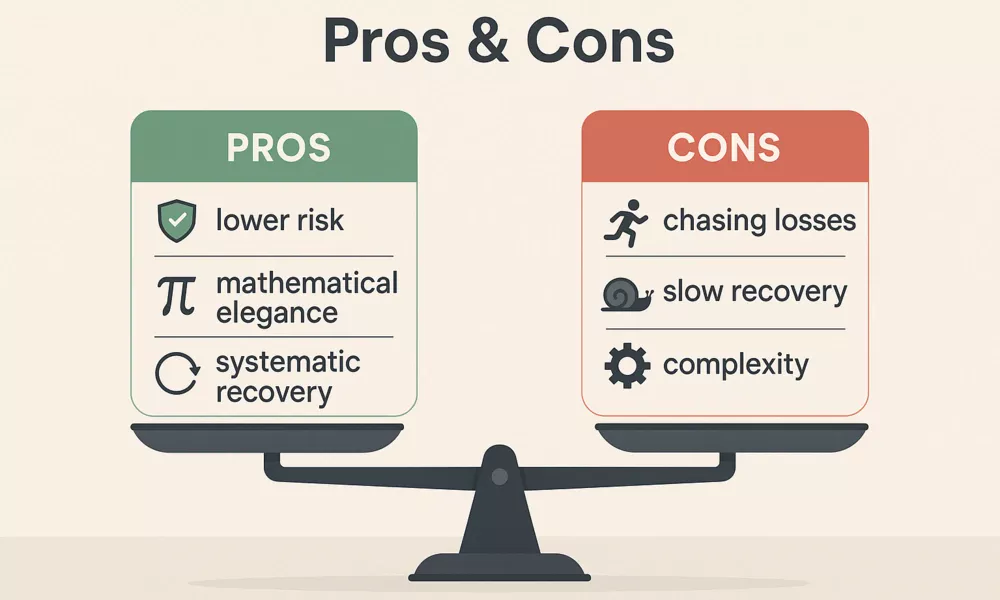
The advantages start with slower risk escalation. Compared to Martingale or other aggressive progressions, Fibonacci increases stakes gradually. This gives you breathing room during losing streaks. You can sustain longer runs of bad luck without exhausting your bankroll or hitting maximum bet limits. For bettors with limited funds, this sustainability is genuinely valuable.
The mathematical elegance appeals to analytically-minded bettors. Following a famous mathematical sequence feels more sophisticated than arbitrary doubling. There’s psychological comfort in using a system with centuries of mathematical pedigree. This might sound silly, but betting is as much psychology as mathematics. If using Fibonacci helps you maintain discipline and avoid impulsive bets, that’s worth something.
Recovery happens systematically rather than desperately. Unlike flat betting where losses just accumulate with no recovery mechanism, Fibonacci offers a structured path back to profit. Unlike Martingale where recovery requires one massive bet, Fibonacci lets you recover gradually across multiple wins. This feels more achievable psychologically.
The system provides clear rules and structure. You always know your next stake it’s dictated by the sequence. This eliminates decision paralysis and emotional betting. You’re not guessing how much to bet based on hunches or feelings. The sequence tells you. That discipline is valuable for bettors prone to impulsive decisions.
Now the disadvantages, which are substantial and sobering.
The fundamental problem persists: you’re still chasing losses. Any negative progression system means betting more when you’re losing. If you’re making negative EV bets, this compounds your expected losses. You’re increasing exposure precisely when you should be reducing it. The mathematics are unforgiving here.
Recovery is slower than Martingale. Because stakes increase gradually, you need multiple wins to climb back from deep in the sequence. If you’re at position eight or nine in Fibonacci, one win isn’t enough. You might need three or four wins to fully recover. During that climb, you could easily lose again and slide back deeper. The recovery process can be frustratingly slow.
Tracking requirements create room for error. You must know your current position in the sequence and remember to move back two spots after wins. Miss track once and your entire progression breaks. Write down your position if necessary, but that adds friction and complexity. Mistakes in Fibonacci progressions can be costly because you might bet wrong amounts for several bets before noticing.
Extended losing streaks still destroy bankrolls eventually. Fibonacci is safer than Martingale, but it’s not safe. Hit a truly brutal losing streak twelve, fifteen, twenty losses and you’re still facing ruin. The gentler slope means you hit the cliff edge slightly later than Martingale, but you still hit it. No progression system survives infinite losses with finite bankroll.
The system requires compatible odds ranges. Fibonacci works best on relatively even odds. Bet heavy favorites at 1.30 and your win profits don’t recover enough previous losses. Bet longshots at 4.00 and you’ll likely extend losing streaks due to lower win probability. You need odds between roughly 1.80 and 2.20 for optimal progression function. This limits bet selection.
Psychological pressure still mounts during losing streaks. Yes, it’s less intense than Martingale. But by position seven or eight in the sequence, you’re still betting uncomfortable amounts relative to your bankroll. The stress accumulates. Sleep quality suffers. You watch games with clenched teeth. The mental toll is real even if it’s less severe than other progressions.
Who shouldn’t use Fibonacci? Anyone betting with scared money they can’t afford to lose. Beginners who should be learning bankroll management and value identification instead of staking systems. Professional bettors who’ve moved beyond progression systems to proper Kelly staking or flat betting. Anyone who thinks Fibonacci will make them profitable despite poor selection ability.
The Fibonacci betting system is a beautiful mathematical construction applied to an ugly problem loss chasing. It does the job better than most alternatives, but that doesn’t make it good. It makes it less bad. Understand the distinction before risking your bankroll on graduated losses instead of catastrophic ones.
See also: betsystemexpert – strategies and systems for betting.
See also: Kelly Criterion – a mathematical approach to stake sizing.
