
The Martingale Betting System: Does Doubling Down Actually Work?
 Available in US
Walk into any casino, scroll through any betting forum, or chat with anyone who’s dabbled in sports gambling, and you’ll eventually hear about the Martingale system. It’s the betting strategy that refuses to die, despite decades of mathematicians, professional gamblers, and bitter experience screaming warnings. The appeal is intoxicating: a system that seemingly guarantees you’ll win back all your losses plus a profit. What could possibly go wrong?
Quite a lot, actually. But before we get into why the Martingale has destroyed more bankrolls than bad luck and poor judgment combined, let’s understand what makes it so seductive in the first place. Because here’s the uncomfortable truth the Martingale works brilliantly right up until the moment it catastrophically doesn’t. That’s what makes it dangerous. It’s not obviously flawed like betting your mortgage on a single roulette spin. It looks scientific, methodical, almost foolproof. People win with it for weeks, sometimes months, before the inevitable collapse.
I’m not writing this to sell you the Martingale. Quite the opposite. I want to explain exactly how it works, why it seems to work, and more importantly, why it ultimately fails. If you understand the mechanics and mathematics, you’ll never fall for the siren song of “guaranteed recovery” systems. And if you’re already using Martingale? Well, let’s just say I hope your bankroll survives long enough to finish reading this.
What is the Martingale System?
The Martingale betting system originated in 18th century France, though its name likely comes from a London gambling house owner named Henry Martindale who encouraged losing gamblers to “double up” their bets. The system itself is elegantly simple, which partially explains its enduring popularity. Simple ideas spread easily, even when they’re terrible ideas.
Here’s the basic principle: every time you lose a bet, you double your stake on the next wager. When you eventually win and probability suggests you must win eventually you’ll recover all previous losses plus a profit equal to your original stake. Then you reset to your starting bet and begin the sequence again.
Let’s walk through a concrete example because this is where the system’s appeal becomes obvious. You decide to bet on even-money outcomes think red or black in roulette, or point spreads in sports betting priced around -110. Your starting stake is ten dollars.
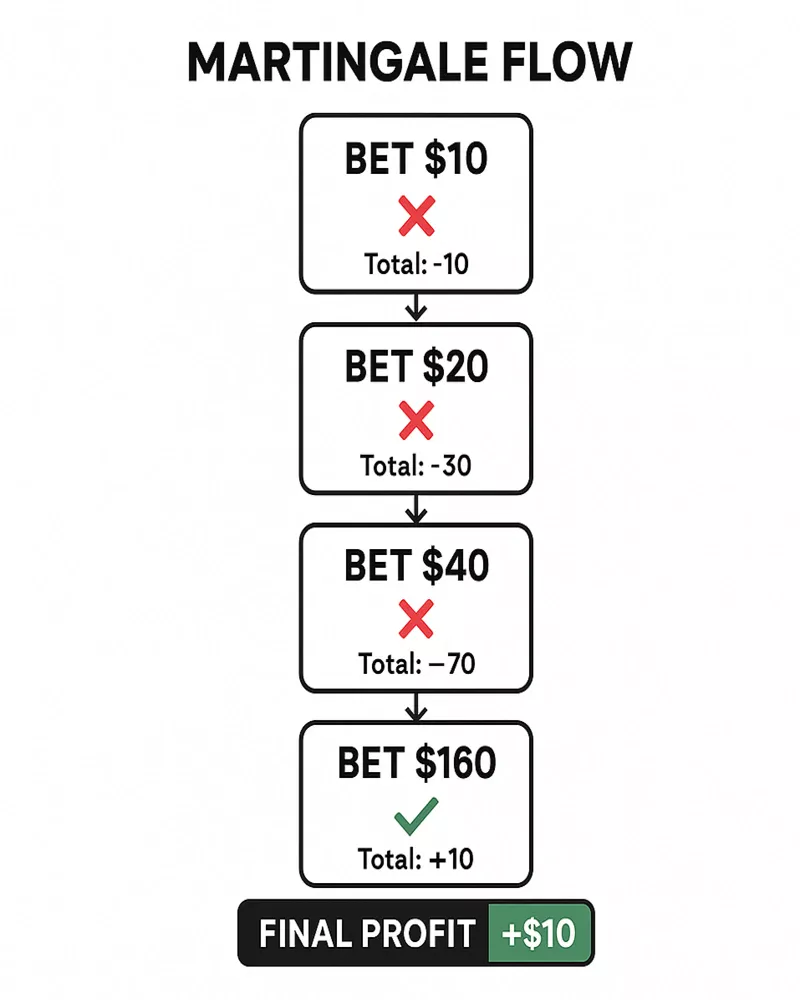
Bet one: you wager ten dollars and lose. You’re down ten dollars total. Bet two: you double to twenty dollars. If you win this one, you collect forty dollars total (your twenty dollar stake returned plus twenty dollars profit). Since you lost ten dollars on the first bet, your net position is now ten dollars profit. Back to square one, mission accomplished.
But what if bet two also loses? Now you’re down thirty dollars total (ten plus twenty). Bet three becomes forty dollars. Win this, and you collect eighty dollars. Subtract the thirty dollars you’ve lost, and you’re back to a ten dollar profit. See the pattern? No matter how long the losing streak runs, one win at the doubled stake recovers everything and leaves you with that original ten dollar profit.
The mathematical elegance is undeniable. In a simplified world of unlimited bankrolls and no table limits, the Martingale is unbeatable. You absolutely will win eventually. The problem, of course, is that we don’t live in that simplified world.
How Martingale Works in Sports Betting
Adapting Martingale from casino games to sports betting introduces complications because sports bets rarely offer true even-money odds. When you see -110 on both sides of a point spread, you’re not getting one-to-one odds. You’re risking 110 dollars to win 100 dollars. This means your recovery calculation needs adjustment.
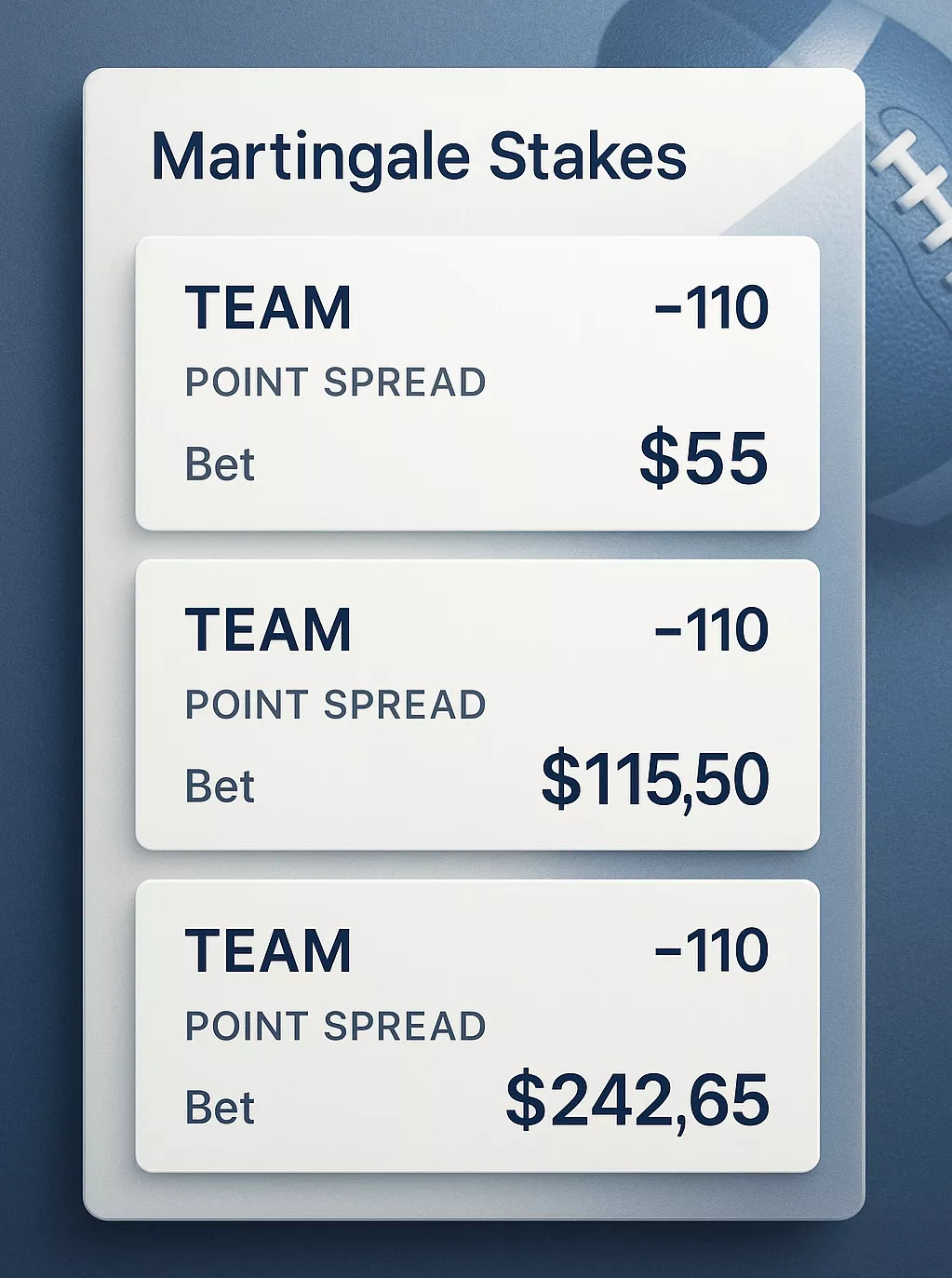
The adaptation formula is straightforward but critical: to recover previous losses and achieve your target profit, you need to stake an amount equal to (total previous losses plus desired profit) divided by the decimal odds minus one. If you’re betting at American odds of -110, that’s decimal odds of 1.909. So your required stake becomes (losses plus profit) divided by 0.909.
Let’s work through a sports betting example with this adjusted formula. You’re betting NFL point spreads at standard -110 odds. Your base unit is fifty dollars, and you want each successful sequence to profit fifty dollars.
First bet: fifty dollars at -110. You need to risk fifty-five dollars to win fifty dollars (that’s how -110 works risk 110 to win 100, so scale proportionally). This bet loses. You’re down fifty-five dollars.
Second bet: you need to recover fifty-five dollars and profit fifty dollars, so 105 dollars total recovery target. At -110 odds, you must stake 105 divided by 0.909, which equals roughly 115.50 dollars. This bet also loses. You’re now down 170.50 dollars total.
Third bet: recovery target is 170.50 plus 50 equals 220.50. Required stake is 220.50 divided by 0.909, approximately 242.65 dollars. Notice how quickly this escalates? And we’re only three bets deep with fairly modest starting stakes.
The progression accelerates faster than most people anticipate when they first encounter the system. After seven consecutive losses at -110 odds starting from fifty dollar base stakes, you’re looking at a required stake exceeding seven thousand dollars just to recover everything and make your fifty dollar profit. That’s a lot of risk for minimal reward.
This is where Martingale users in sports betting often modify the system, sometimes betting at better odds (like +100 or higher) to slow the progression. But this introduces new problems. Higher odds typically mean lower probability outcomes. You’re more likely to extend your losing streak, which defeats the purpose of the progression strategy.
Some bettors try Martingale on favorites with short odds, like -200 or -300, thinking the high win probability protects them. But now your recovery calculation gets brutal. At -200 (decimal 1.50), you must stake double your loss amount just to break even. At -300 (decimal 1.33), you’re staking three times your losses. The progression becomes unsustainable almost immediately.
The Mathematics Behind Martingale
Let’s dig into the actual mathematics because this is where the system’s fundamental flaw becomes undeniable. The Martingale feels like it should work because of something called the gambler’s fallacy the mistaken belief that past independent events influence future probabilities.
When you’ve lost seven bets in a row, your brain screams that you’re “due” for a win. The universe owes you one. Surely eight losses in a row is impossibly unlikely. Except it’s not. Each bet is an independent event. The roulette wheel doesn’t remember that it just hit black seven times. The football game doesn’t care about your betting history. The probability of your next bet winning is exactly the same as your first bet, assuming the odds haven’t changed.
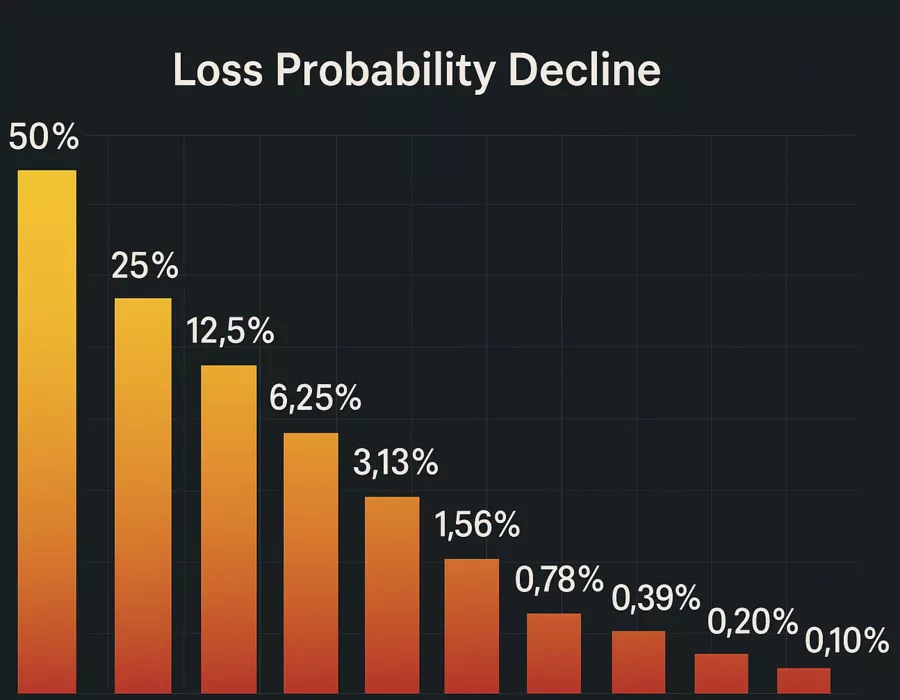
Here’s the probability breakdown that destroys the Martingale illusion. Let’s say you’re betting on even-money propositions with a true fifty percent win probability (ignoring house edge for now). The probability of losing once is fifty percent. Losing twice consecutively is twenty-five percent. Three times is 12.5 percent. By the time you hit eight consecutive losses, you’re at 0.39 percent unlikely but far from impossible.
Now factor in the house edge. On a -110 bet, you need to win 52.4 percent of the time just to break even. Your actual win probability on any given bet is probably closer to fifty percent or slightly worse, depending on your handicapping skill. This means longer losing streaks occur more frequently than pure fifty-fifty probabilities would suggest.
The expected value calculation kills the Martingale stone dead. Expected value is (probability of winning times profit) minus (probability of losing times loss). For a -110 bet, assuming fifty percent win probability, your EV is (0.5 times 100) minus (0.5 times 110), which equals negative five dollars per 110 dollar risked. That’s roughly negative 4.5 percent.
The Martingale progression doesn’t change your expected value. You’re still making negative EV bets. The progression just redistributes when those losses hit. Instead of losing small amounts frequently, you lose massive amounts infrequently. The long-term outcome is identical you lose at the same percentage rate. The only difference is variance and the psychological experience of the journey.
Mathematically, the Martingale is a variance-reduction strategy that trades frequent small wins for rare catastrophic losses. You’ll win many sessions, each showing modest profit. Then, once in a while, you’ll lose an amount that wipes out months of grinding. The cumulative result matches what you’d have lost betting flat stakes, but the emotional roller coaster is vastly different.
There’s a concept called “risk of ruin” that’s crucial here. This calculates the probability that you’ll deplete your entire bankroll before achieving a target profit. With Martingale, your risk of ruin is extraordinarily high because the progression demands exponentially increasing stakes. A bankroll that seems adequate when you start becomes woefully insufficient after five or six consecutive losses.
Professional gamblers often quote the Kelly Criterion as the mathematically optimal staking strategy. Kelly tells you to bet a percentage of your bankroll proportional to your edge. For negative EV bets, Kelly says bet zero. Martingale says bet progressively larger amounts on negative EV propositions. It’s the exact opposite of optimal strategy.
The Critical Flaws
Beyond the mathematics, the Martingale system suffers from practical flaws that doom it even when users don’t fully understand the probability arguments.
Table limits and maximum bets represent the most immediate practical barrier. Every bookmaker and casino imposes maximum bet sizes. In sports betting, these limits might be five thousand, ten thousand, or twenty-five thousand dollars depending on the sport, market, and book. Once your required stake exceeds the maximum, your progression breaks. You can’t recover your losses because you’re literally not allowed to place the necessary bet.
I’ve seen this happen in real-time. A bettor starts with twenty dollar stakes, hits a horrific run, and by bet number nine needs to wager 10,240 dollars to continue the sequence. But their bookmaker’s limit on that market is five thousand dollars. They’re stuck. They can’t complete the progression. All those losses are now unrecoverable through the Martingale framework. They’ve lost thousands of dollars chasing twenty dollar profits, and they can’t even execute their system anymore.
Exponential stake growth catches people off guard even when they know about it intellectually. You understand that doubling means two, then four, then eight, but you don’t emotionally process what that means until you’re staring at a bet slip asking you to risk thousands. The human brain isn’t wired to grasp exponential growth intuitively. We think linearly. When you’re on bet six or seven, the stakes feel surreal.
Here’s a table that makes the progression visceral. Starting with a ten dollar bet on even-money odds:
Bet one: 10 dollars, total risked 10 dollars. Bet two: 20 dollars, total risked 30 dollars. Bet three: 40 dollars, total risked 70 dollars. Bet four: 80 dollars, total risked 150 dollars. Bet five: 160 dollars, total risked 310 dollars. Bet six: 320 dollars, total risked 630 dollars. Bet seven: 640 dollars, total risked 1,270 dollars. Bet eight: 1,280 dollars, total risked 2,550 dollars. Bet nine: 2,560 dollars, total risked 5,110 dollars. Bet ten: 5,120 dollars, total risked 10,230 dollars.
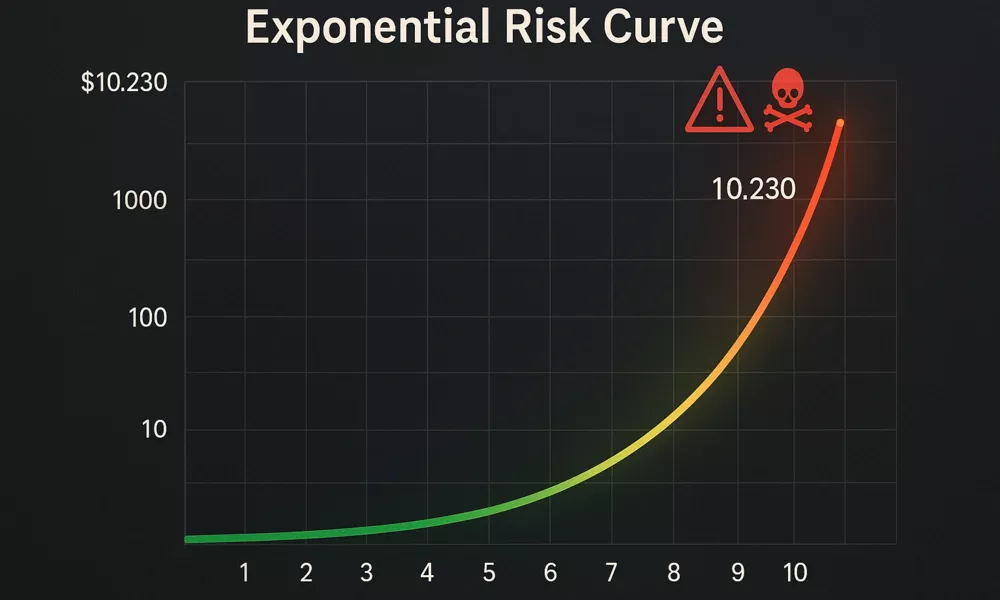
You started wanting to make ten dollars. After ten straight losses, you’ve risked over ten thousand dollars. Does that seem like a sensible risk-reward proposition? The asymmetry is grotesque.
Psychological pressure becomes unbearable as stakes escalate. When you’re betting ten or twenty dollars, a loss stings but doesn’t devastate. You can absorb it and move on. When you’re betting two thousand dollars because the progression demands it, every second of that event is torture. Your stomach churns. You can’t focus on anything else. If you’re watching a game, every play feels like your financial life hanging in the balance. Because it might be.
This pressure leads to terrible decision-making. Maybe you hedge mid-game. Maybe you cash out early, breaking your sequence. Maybe you deviate from your system entirely, making impulse bets to “make up for it faster.” Discipline evaporates under that kind of stress. The system requires you to be a robot, emotionlessly executing the progression regardless of circumstances. Humans aren’t robots.
Bankroll requirements for safe Martingale use are absurd when you calculate them properly. If you want to survive ten consecutive losses starting from a ten dollar base unit on even-money bets, you need approximately 10,230 dollars available. That’s 1,023 times your base bet. Most bankroll management advice suggests your base bet should be one to two percent of your total bankroll. If your base bet is one percent, you’d need roughly 102,300 dollars to safely execute Martingale through ten losses.
How many casual bettors have six-figure bankrolls? And if you do have that kind of money, do you really want to risk 10,230 dollars to make ten dollars? The math makes no sense from a risk-adjusted return perspective. You could earn better risk-free returns putting that money in treasury bonds.
The illusion of recovery is perhaps the most insidious flaw. The Martingale works so many times that it creates false confidence. You’ll successfully complete dozens, maybe hundreds of sequences, each delivering that small profit. Your brain starts believing the system is valid. You’ve proven it works through extensive testing. Then the catastrophic losing streak arrives, and you lose everything.
This is a cognitive bias called survivorship bias. You’re only analyzing the sequences that completed successfully while ignoring or minimizing the eventual sequence that destroys you. Casinos and bookmakers love Martingale users for exactly this reason. They know you’ll win most sessions, feel smart, keep coming back, and eventually donate your entire bankroll in one disastrous session.
The gambler’s fallacy drives Martingale thinking fundamentally. The system only makes intuitive sense if you believe losing streaks “must” end soon. But they don’t must anything. Probability is memoryless. Your seventh bet has the same win probability as your first. The universe doesn’t balance out on any time frame relevant to your bankroll. Variance can cluster losses in ways that bankrupt you long before regression to the mean occurs.
When (If Ever) Martingale Makes Sense
This section will be short because there are vanishingly few circumstances where Martingale is defensible.
The only theoretical scenario where Martingale works is if you possess unlimited bankroll, face no maximum bet limits, and plan to bet indefinitely. In that impossible scenario, you will eventually win and profit. But you don’t have unlimited money. Bookmakers do impose limits. And you’re not immortal with infinite time to wait out variance.
Some argue Martingale works for very short-term entertainment gambling where you’re prepared to lose your entire bankroll but want to maximize your time at the table or in action. If you’ve budgeted two hundred dollars for an evening’s entertainment and don’t care about expected value, Martingale might extend your play time by converting losses into eventual wins more often than not. But the moment you hit that streak, your entertainment budget evaporates instantly. Is that fun?
There’s an extremely narrow use case for modified Martingale in matched betting or arbitrage situations where you’re exploiting promotions or guaranteed profit opportunities. But even here, you’re not really using Martingale as a recovery system. You’re just sizing bets progressively while maintaining your edge. It’s technically Martingale-esque staking but fundamentally different because you’re not betting into negative expectation.
Realistically, Martingale makes sense never. The only reason to use it is if you fundamentally misunderstand probability or refuse to accept mathematical reality. That sounds harsh, but it’s accurate. Every legitimate gambling mathematician, every successful professional bettor, every casino expert says the same thing: don’t use Martingale. If you think you’ve found the exception, you’re wrong.
Safer Alternatives to Martingale
If you’re attracted to progression systems, several alternatives are substantially safer than Martingale while still offering the psychological satisfaction of structure and recovery mechanisms.
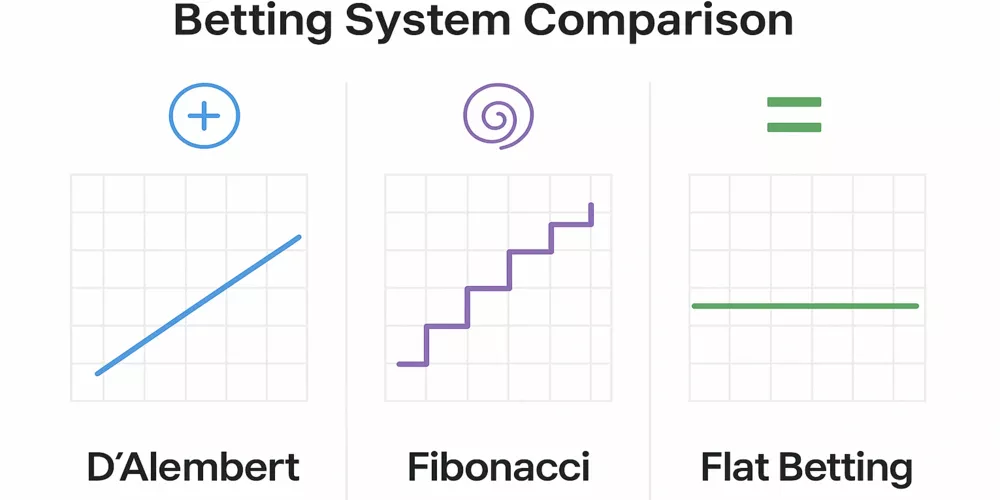
The D’Alembert system provides a gentler progression slope. Instead of doubling after losses, you increase by one unit. Instead of halving after wins, you decrease by one unit. If you start at ten dollars and lose, your next bet is twenty dollars, then thirty dollars, and so on. This creates a much more manageable escalation. You can sustain longer losing streaks without exponential stake growth destroying your bankroll.
The D’Alembert operates on the assumption that wins and losses will eventually balance out, and when they do, you’ll be ahead because you bet more during your losing phases. The flaw is that this equilibrium assumption doesn’t hold when you’re betting into negative expectation with house edge. But at least D’Alembert won’t bankrupt you in eight bets like Martingale can.
The Fibonacci system uses the famous number sequence where each number is the sum of the previous two. Your progression goes one, one, two, three, five, eight, thirteen, twenty-one, and so on. After a loss, you move one step forward in the sequence. After a win, you move two steps backward. This creates a recovery mechanism similar to Martingale but with slower stake growth.
Fibonacci is substantially safer than Martingale because the progression is less aggressive. You can survive longer losing streaks. The psychological appeal remains you’re still “chasing” losses with a system. But you’re doing it in a way that won’t obliterate your bankroll quite as quickly. It’s still not a winning strategy long-term, but it’s less dangerous than Martingale.
Flat betting is what professionals actually use. You bet the same amount every time, typically one to three percent of your total bankroll. This approach accepts variance as inevitable and focuses on long-term edge rather than short-term recovery. It’s boring. There’s no excitement of recovering losses dramatically. But it works because it doesn’t blow up your bankroll during inevitable losing streaks.
Flat betting forces you to focus on the only thing that actually matters: are you making positive expectation bets? If yes, flat betting amplifies your edge efficiently. If no, flat betting loses you money slowly rather than catastrophically. Either way, it’s the professional standard for good reason.
The hard truth about all progression systems: they’re psychologically appealing because humans hate losses and love the idea of guaranteed recovery. But progression systems are emotional band-aids applied to negative expectation gambling. They make you feel better about losing by changing when and how the losses occur, but they don’t change the fundamental mathematics. You’re still betting into negative EV. The house edge doesn’t care about your staking system.
If you’re serious about sports betting or gambling generally, focus on finding positive expectation opportunities through superior handicapping, better information, or exploiting promotions. Then use sensible flat betting with proper bankroll management. That’s the actual path to long-term success. Martingale is the path to eventual ruin with a lot of false hope along the way.
The system survives and thrives because it works just enough, just long enough, to convince people it’s valid. Then it doesn’t work at the worst possible moment. Learn the mathematics, understand the flaws, and save yourself the pain of discovering them through bankroll destruction. The Martingale is a beautiful, elegant, completely doomed betting system. Admire it from a distance if you must, but never trust your money to it.
See also: betsystemexpert – compare every betting system.
See also: Fibonacci Betting System – a less aggressive progression method.
