
Flat Betting Strategy: The Simple System That Actually Works
 Available in US
Every bettor eventually faces the seductive call of progression systems. Double after losses to recover faster. Increase stakes when you’re hot to maximize wins. Follow complex sequences that promise structured profit. These systems sound sophisticated, scientific even, until they bankrupt you during a perfectly normal losing streak that every bettor experiences eventually.
Flat betting is the antidote to all that noise. It’s almost insultingly simple: bet the same amount every single time, regardless of whether you just won five in a row or lost eight straight. No calculations. No sequences to remember. No emotional decisions about whether this bet deserves more or less than the last one. Just pick your unit size and never deviate. That’s it. That’s the entire system.
The simplicity makes it easy to dismiss as unsophisticated or boring, which is exactly why most bettors ignore it in favor of sexier alternatives. But here’s what professional sports bettors and successful long-term gamblers know: flat betting is the foundation of sustainable gambling. It’s not the most exciting approach. It won’t create dramatic comeback stories where you recovered a losing month in one glorious afternoon. What it will do is keep you in the game long enough for actual skill to manifest, protect you from emotional decision-making, and ensure that variance doesn’t destroy your bankroll before you’ve had a fair chance to demonstrate whether you can actually beat the market.
This isn’t about selling you flat betting as some magic bullet that guarantees profits. If you’re making negative expectation bets and most casual bettors are flat betting will lose you money just like any other system. The difference is it loses you money slowly and predictably rather than catastrophically and suddenly. If you’re making positive expectation bets through superior analysis or information, flat betting amplifies that edge cleanly without interference from money management complications. Either way, it’s the professional standard for sound reason.
What is Flat Betting?
Flat betting means wagering the same fixed amount on every bet you place, with no adjustment based on previous results, current bankroll fluctuations, or perceived confidence levels. You decide on a unit size typically a small percentage of your total bankroll and you bet that amount consistently across all wagers. Win or lose, the next bet is the same size as the last.
The core philosophy removes all emotional and psychological variables from stake sizing. You’re not making decisions in the heat of the moment about how much to risk. You’re not increasing bets because you “feel hot” or decreasing them because you’re “running cold.” You’ve predetermined your stake size through rational analysis when you weren’t influenced by recent results, and you stick to it mechanically.
This approach flies in the face of human nature, which is precisely why it works. We’re wired to want to press advantages when things are going well and either chase losses or retreat entirely when things go poorly. These instincts served us well on the African savanna fifty thousand years ago but they’re financial poison in modern gambling. Flat betting overrides those instincts through rigid adherence to predetermined rules.
The unit size you choose is crucial because it determines both your risk exposure and longevity. The standard recommendation is one to three percent of your total bankroll per bet, with the exact percentage depending on your confidence in your edge, your risk tolerance, and the variance of your betting markets. Conservative bettors might go as low as 0.5 percent. Aggressive bettors might push to five percent, though this increases risk of ruin substantially.
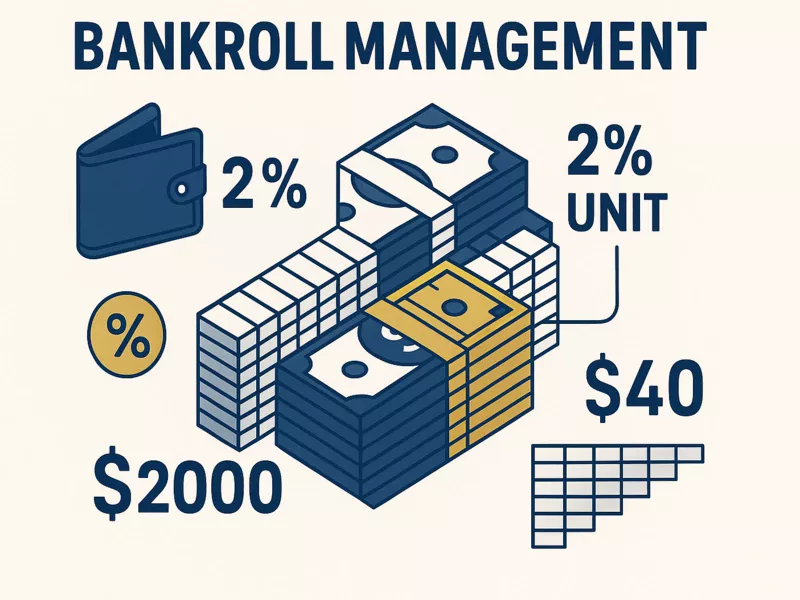
Let’s make this concrete with an example. You’ve set aside two thousand dollars as your betting bankroll money you can afford to lose without lifestyle impact. You decide on a two percent unit size, which means forty dollars per bet. From this point forward, every bet you place is forty dollars. You bet on NFL point spreads forty dollars. You bet on Premier League match winners forty dollars. You bet on NBA player props forty dollars. The bet type, the odds, your recent results, none of it matters. Forty dollars is your stake, period.
The key distinction between flat betting and other approaches is the absence of conditional logic. There’s no “if I lose then stake X” or “if I win then stake Y.” There’s just stake X always. This eliminates decision paralysis and removes opportunities for emotional interference. You’ve simplified the betting process down to two questions: What should I bet on? (Selection) And is it worth my unit stake? (Value assessment). The question of how much to bet has a permanent, predetermined answer.
How to Implement Flat Betting
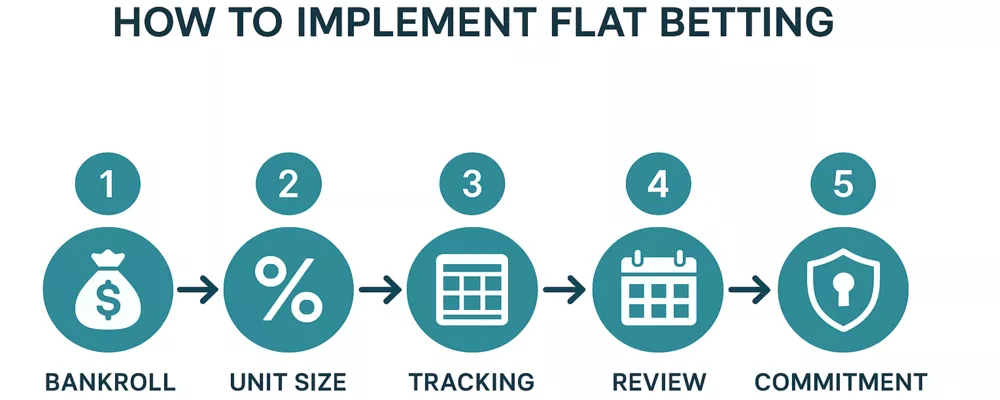
The implementation mechanics are straightforward but require upfront decisions that shape your entire approach. Getting these foundational elements right is more important than any individual bet you’ll place.
First, determine your bankroll. This isn’t your checking account balance or available credit. It’s money specifically allocated to gambling that you can lose entirely without financial hardship. If losing this money means you can’t make rent or buy groceries, it’s not gambling bankroll it’s money you need, and you shouldn’t be betting it at all. Be honest here. Most betting disasters start with people lying to themselves about what they can afford to risk.
A realistic minimum bankroll for serious flat betting is probably five hundred to a thousand dollars if you’re betting typical 1.90 to 2.10 odds. Less than that and your unit sizes become so small that the grind feels pointless. More is obviously better it allows for larger units and more meaningful returns without increasing percentage risk. But the key is that whatever amount you designate, it’s truly expendable.
Second, choose your unit size as a percentage. The mathematical reality is that lower percentages reduce your risk of ruin but also slow your bankroll growth if you have genuine edge. Higher percentages increase both potential growth and potential ruin. The sweet spot for most bettors is between one and three percent, calibrated based on several factors.
If you’re betting into efficient markets where you expect only marginal edge say you think you can hit 53 percent on NFL spreads against the 52.4 percent needed to break even against vig you should bet smaller, probably one percent. Your edge is thin and variance is high. You need longevity to let that edge manifest. If you’re betting into less efficient markets where you believe you have substantial edge maybe niche prop bets or lower-league soccer where your analysis identifies genuine mispricings you can afford two to three percent because your expected win rate is higher.
Risk tolerance matters too. Some people sleep fine knowing they might lose twenty percent of their bankroll during a bad month. Others start making terrible decisions when down ten percent. Know yourself. If you’re the second type, bet smaller units. The psychological sustainability of your approach matters as much as the mathematics.
Third, establish tracking systems. You absolutely must record every bet you place with complete data: date, selection, odds, stake, result, profit or loss. This isn’t optional. Without meticulous records, you cannot assess whether you’re actually winning or losing, identify patterns in your betting that might indicate edges or leaks, or make informed decisions about adjusting your approach.
The discipline of tracking serves a second purpose beyond data collection: it creates accountability. When you know you’re logging every bet, you’re less likely to make impulsive wagers because you’ll have to record and confront them later. The act of writing down that you bet on a random Tuesday night NBA game for no analytical reason makes you feel foolish, which is good it should feel foolish because it is foolish.
Fourth, set review periods. Every month or quarter, analyze your records. Calculate your win rate, return on investment, and performance by bet type or sport. This review accomplishes two things: it shows you whether you’re actually profitable (most people overestimate their success without data), and it identifies where your edges are if any exist.
These reviews are also when you adjust unit size based on bankroll changes. If you started at two thousand dollars with forty-dollar units (two percent) and you’re now at twenty-five hundred dollars, your new units become fifty dollars to maintain that two percent ratio. If you’re down to fifteen hundred, drop to thirty-dollar units. This scaling ensures you’re never betting too much relative to remaining bankroll.
Fifth, commit to the system. This is the hard part. Flat betting only works if you actually flat bet consistently over meaningful sample sizes. You can’t flat bet for two weeks, have a bad run, panic and start progression betting to recover, then return to flat betting when things stabilize. That’s not flat betting that’s chaos. The system requires discipline through variance, which means betting your unit when you’re winning, when you’re losing, when you’re bored, when you’re excited, always.
Most bettors fail flat betting not because the system doesn’t work but because they lack the discipline to implement it consistently. They’ll flat bet for fifty bets, lose twelve of the last fifteen, and suddenly they’re doubling stakes to recover or betting scared at half units. This undermines everything. Variance is normal. Losing streaks are inevitable. The whole point of flat betting is surviving those stretches without making catastrophic adjustments.
The Mathematics of Flat Betting
Understanding the mathematical foundation of flat betting helps you appreciate why professionals favor it despite its simplicity. The math isn’t complicated, but it reveals important truths about long-term gambling outcomes.
Break-even win rate is the fundamental calculation. Against standard -110 odds common in sports betting, you need to win 52.38 percent of your bets to break even. Here’s why: at -110, you’re risking 110 to win 100, or risking 1.1 units to win 1.0 units. So your payout on winning bets is 1.909 times your stake (the 1.0 unit profit plus your 1.1 unit stake back equals 2.1, divided by 1.1 staked equals 1.909). To find break-even, you solve: win rate times 1.909 equals 1.0 (your stake). That gives you 52.38 percent.
These margins are thin, which is why flat betting makes sense. If you genuinely have a 54 percent win rate already a legitimate edge that most bettors don’t possess you’re only beating the market by 1.62 percent of money wagered. Your edge is fragile. Any money management system that increases variance or exposure during losing streaks threatens to overwhelm that edge through bad luck. Flat betting preserves your edge cleanly by minimizing variance introduction from stake sizing.
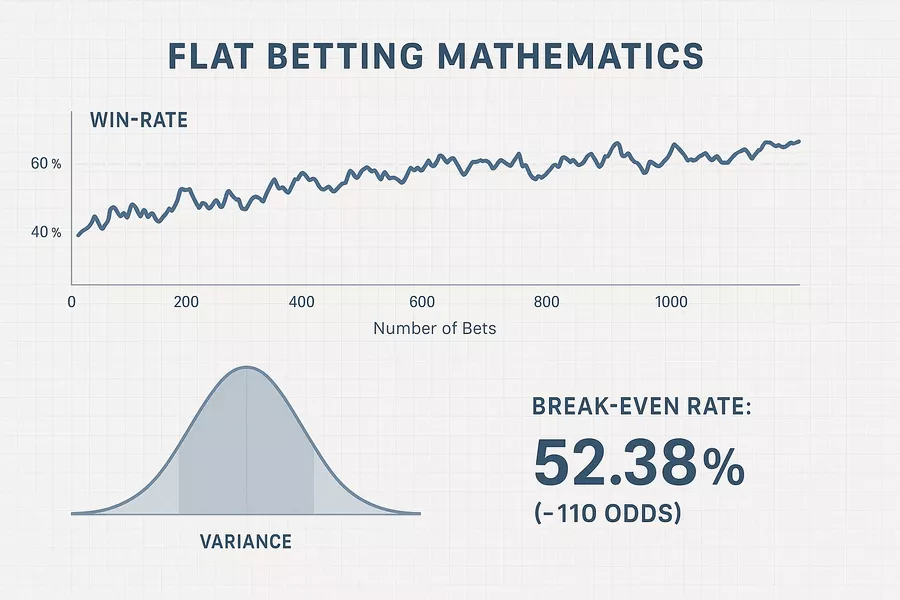
Expected value across flat betting is straightforward to calculate. If you’re betting into -110 odds with a true fifty percent win rate (meaning you’re picking randomly or betting equally on both sides), your expected value is negative 4.55 percent per dollar wagered. Over one thousand bets at forty dollars each, that’s negative 1,820 dollars expected. Flat betting doesn’t change this you’re still losing at that rate. But flat betting loses you exactly that amount steadily rather than varying wildly based on when wins and losses cluster.
If you’re winning 54 percent at -110 (a legitimate edge), your expected value is positive 1.62 percent per dollar wagered. Over one thousand bets at forty dollars, that’s positive 648 dollars expected. Flat betting maximizes this return relative to risk taken because you’re not overexposing during variance downswings or underexposing during hot streaks. Your edge compounds cleanly over volume.
Variance and standard deviation determine how much your results will fluctuate around expected value. Even with genuine edge, you’ll experience losing stretches that test your resolve. Understanding variance helps you maintain discipline when short-term results don’t reflect long-term expectation.
This is why flat betting requires commitment to large sample sizes. After five hundred bets at 54 percent edge, you’d expect to be up about eight units, with one standard deviation ranging from negative 14 units to positive 30 units. You’re still not guaranteed profit. By one thousand bets, expected value is 16 units with one standard deviation from negative 15 units to positive 47 units. Finally you’re reaching sample sizes where genuine edge becomes reliably visible above noise.
The mathematical takeaway: flat betting doesn’t eliminate variance. No system can. What it does is ensure variance comes purely from bet outcomes, not from stake sizing decisions that amplify losses. You’re accepting whatever variance naturally exists in your betting markets without adding variance from money management.
Risk of ruin calculates probability you’ll lose your entire bankroll. With flat betting at one to three percent units, your risk of ruin is surprisingly low even without edge, assuming you’re not betting into extreme negative expectation. At two percent units and fifty percent win rate (no edge but no disadvantage beyond small vig), your risk of ruin is under one percent over hundreds of bets. The bankroll would have to suffer such an improbable losing streak that you’d need to lose sixty-five percent of a large sample, which won’t happen at fifty percent true win rate.
If you have positive edge say 54 percent at -110 your risk of ruin approaches zero with proper flat betting. The edge compounds over volume while the consistent unit sizing prevents catastrophic drawdowns. Compare this to Martingale where risk of ruin is virtually one hundred percent given enough time, or Fibonacci where it’s still substantial. Flat betting minimizes ruin risk because you’re never overexposed relative to bankroll.
Flat Betting vs Progressive Systems
The comparison between flat betting and progression systems reveals fundamental philosophical differences about risk, reward, and gambling psychology. Understanding these differences helps you choose appropriate approaches for your situation.
Flat betting versus Martingale is the starkest contrast. Martingale doubles stakes after losses, attempting rapid recovery. Flat betting maintains stakes regardless of results. Martingale creates high variance frequent small wins punctuated by rare catastrophic losses. Flat betting creates low variance steady grinding in either direction based on your actual win rate.
If you have genuine edge, flat betting is mathematically superior. It exposes you to less variance per unit of edge extraction. Martingale’s doubling creates situations where you’re massively overexposed during losing streaks, risking enormous amounts to win small profits. If your edge is real, you don’t need progressive stakes to exploit it volume with consistent sizing works more efficiently.
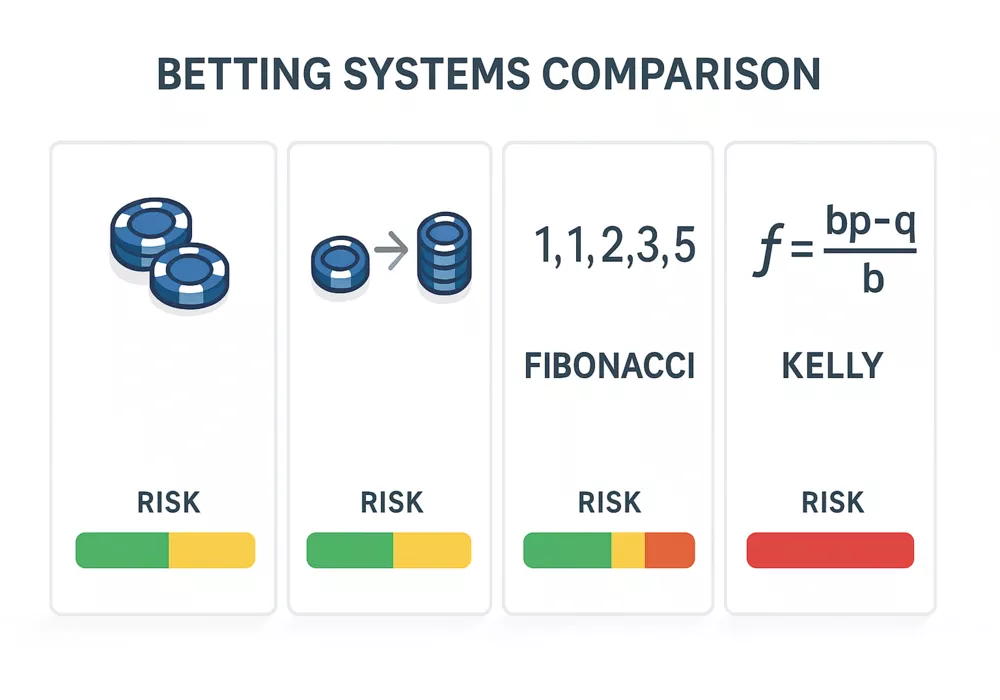
Flat betting versus Fibonacci is comparing conservative progression to no progression. Fibonacci increases stakes gradually during losing runs, less aggressively than Martingale but still chasing losses. Flat betting never chases. Fibonacci attempts to recover losses through structured progression. Flat betting accepts losses and moves on.
Fibonacci’s only advantage is psychological: some bettors can’t emotionally handle flat betting through long losing streaks without feeling like they’re doing nothing to recover. The progression provides feeling of action and control. But feeling isn’t reality. You’re not controlling outcomes through staking systems. You’re just changing when and how losses manifest.
Flat betting versus Kelly Criterion is comparing the simple version to the mathematically optimal version of rational staking. Kelly Criterion uses a formula to determine optimal bet size based on your edge and the odds offered. When you have edge, Kelly tells you to bet a percentage of bankroll proportional to that edge. When you have no edge, Kelly says bet zero.
Kelly is theoretically superior to flat betting because it scales stakes to your actual advantage on each bet. If you have three percent edge on one bet and eight percent edge on another, Kelly bets more on the second. Flat betting treats both equally. Over time, Kelly compounds bankroll growth faster than flat betting when you have varying edges across different bets.
The broader insight: progressive systems are emotional solutions to mathematical problems. They make bettors feel like they’re doing something active to manage results when really they’re just redistributing variance. Flat betting accepts that variance is inevitable and focuses attention on what actually matters: making good selections. If your picks are good, flat betting profits. If your picks are bad, no staking system saves you.
Advantages of Flat Betting
Let’s enumerate flat betting’s concrete benefits because understanding why professionals favor it helps override the psychological resistance to its simplicity.
Bankroll preservation tops the list. By betting consistent small percentages of your roll, you ensure that no single bet or short losing streak can devastate you. At two percent units, you’d need to lose fifty consecutive bets to lose your entire bankroll. That won’t happen if you’re betting even marginally competently. This longevity is crucial because gambling is inherently variant you need to survive variance long enough for edge to manifest.
Compare this to aggressive systems where ten losses can put you in serious trouble or eliminate you entirely. Flat betting’s conservatism feels boring until the day it saves you from the catastrophic streak that ends other bettors. You’re buying insurance through consistency.

Emotional stability might be flat betting’s most underrated advantage. Gambling creates emotional volatility highs when winning, lows when losing. These emotions compromise judgment. Flat betting dampens emotional swings by reducing stakes to manageable amounts that don’t make or break your financial or emotional state.
When every bet is forty dollars and you’ve got a two-thousand-dollar bankroll, individual bets don’t feel life-changing. You can lose with equanimity and win without euphoria. This emotional evenness prevents the tilt that destroys bettors. You’re not chasing losses desperately or pressing wins recklessly. You’re just betting your unit, emotionally neutral, focused on making good selections.
Simplicity of tracking is massive. Every bet goes in your spreadsheet at the same stake amount. Your profit and loss tracking is clean. You can instantly see your return on investment by dividing total profit by total amount wagered. There’s no complexity from variable stakes making analysis difficult.
This clarity reveals edges clearly. If you’re betting NFL spreads flat and you’re up eight percent on investment, you’ve got an edge. If you’re using progression systems and you’re up eight percent, is that from good picks or from lucky progression timing? Impossible to know. Flat betting isolates selection quality as the variable, making performance assessment accurate.
Psychological compatibility with value betting makes flat betting ideal for serious gamblers. Value betting means betting when odds are higher than your assessed probability of the outcome. If you think a team has sixty percent chance to win but odds imply only fifty-five percent, that’s value. You bet. The selection drives everything.
Flat betting works perfectly here because each value bet gets your standard unit regardless of how much value you think exists. Some advanced bettors scale stakes to perceived value amount, but for most people, simple flat betting on all positive expectation opportunities works excellently. You’re making volume of good bets and trusting mathematics to deliver expected returns.
Professional standard isn’t an advantage per se but it’s worth noting: the vast majority of successful professional sports bettors use flat betting or minor variations thereof. They’re not using Martingale or Fibonacci. They’re betting consistent units or Kelly fractions across their plays. This isn’t coincidence. When people’s livelihoods depend on gambling intelligently, they converge on flat betting because it works.
The advantages compound. Emotional stability leads to better selection decisions. Bankroll preservation ensures you survive long enough to demonstrate edge. Simple tracking reveals where your profits come from. The whole system works synergistically to create optimal conditions for long-term success if and this is critical you’re making positive expectation bets. If you’re not, flat betting just loses money slowly, but that’s still better than losing it quickly.
Disadvantages and Limitations
Flat betting isn’t perfect. Understanding its limitations helps you decide whether it suits your goals and prevents disillusionment when it doesn’t deliver miracles.
Slow profit growth frustrates people accustomed to gambling’s dramatic swings. If you’re betting two percent units and you have legitimate three percent edge, you’re grinding out small profits relative to total bankroll. A good month might see you up six to eight percent. That’s excellent returns by any investment standard but it feels tedious compared to gambling’s potential for doubling or tripling bankrolls.
People come to gambling seeking excitement and rapid wealth accumulation. Flat betting delivers neither. It delivers slow steady grinding. If you’re here for entertainment and adrenaline, flat betting might bore you to tears. The excitement is in selection research and watching outcomes, not in stake sizing and profit volatility.
Inability to capitalize on hot streaks bothers bettors who believe momentum exists. If you win seven in a row, flat betting has you still betting the same amount on bet eight. Progressive bettors argue you should press advantages when you’re hot. The counterargument is that streaks are variance, not skill manifestation, and betting more into variance is precisely wrong.
The mathematics support flat betting here. Unless you have reason to believe your edge increased maybe your handicapping improves during streaks because you’re more focused, though this seems unlikely there’s no reason to bet more. You’re interpreting random clustering as meaningful pattern. Flat betting protects you from this cognitive bias.
Psychological difficulty for many people is real. Humans are wired to want to do something when losing, and flat betting says do nothing except keep betting your unit. The discipline required to flat bet through a twenty-bet losing streak is substantial. Many bettors will break, either chasing with bigger bets or scared betting with smaller units. Either violation undermines the system.
This isn’t flat betting’s weakness it’s human weakness. But it’s worth acknowledging. If you can’t maintain discipline through variance, flat betting won’t work for you not because the system is flawed but because you can’t execute it. Know yourself. If you’re prone to panic or tilt, you need extra safeguards: maybe tracking accountability with someone else, maybe taking breaks during losing streaks, maybe betting smaller units so losses don’t trigger emotional responses.
Missed optimization opportunities are flat betting’s mathematical limitation. If you genuinely have varying edges across different bets five percent edge on some plays, two percent on others flat betting treats them equally. Kelly Criterion would bet more on the five percent edge opportunities, growing bankroll faster. Flat betting leaves money on the table by not scaling to edge magnitude.
The problem is most bettors can’t accurately assess their edges. You think you have five percent edge but really you have two percent. Kelly overbets and performs worse than flat betting. Unless you have extensive historical data proving you can estimate edges accurately, flat betting’s equal treatment is safer.
Requires existing edge to profit is obvious but worth stating. Flat betting is money management, not an edge creator. If you’re betting randomly or into markets where you have no informational advantage, flat betting loses at whatever rate the house edge dictates. It loses slower than Martingale and more steadily than other systems, but it still loses.
The ultimate limitation is that flat betting is boring, which sounds trivial but matters enormously in gambling contexts. People gamble partly for entertainment. The thrill of varying stakes, chasing losses, pressing winners that’s fun for many people. Flat betting removes all that, leaving only the selection process and outcome watching. If that’s not enough entertainment for you, flat betting might be technically correct but personally unsatisfying.
Decide what you want from gambling. If you want optimal long-term financial performance assuming you have edge, flat betting is correct. If you want entertainment and excitement, flat betting might not deliver enough emotional volatility. These are different goals requiring different approaches. Don’t use flat betting for entertainment goals, and don’t use progression systems for optimal financial performance.
See also: betsystemexpert – explore all betting systems.
See also: Martingale Betting System – a progressive alternative to flat betting.
