
Kelly Criterion Explained: The Math Behind Optimal Bet Sizing
 Available in US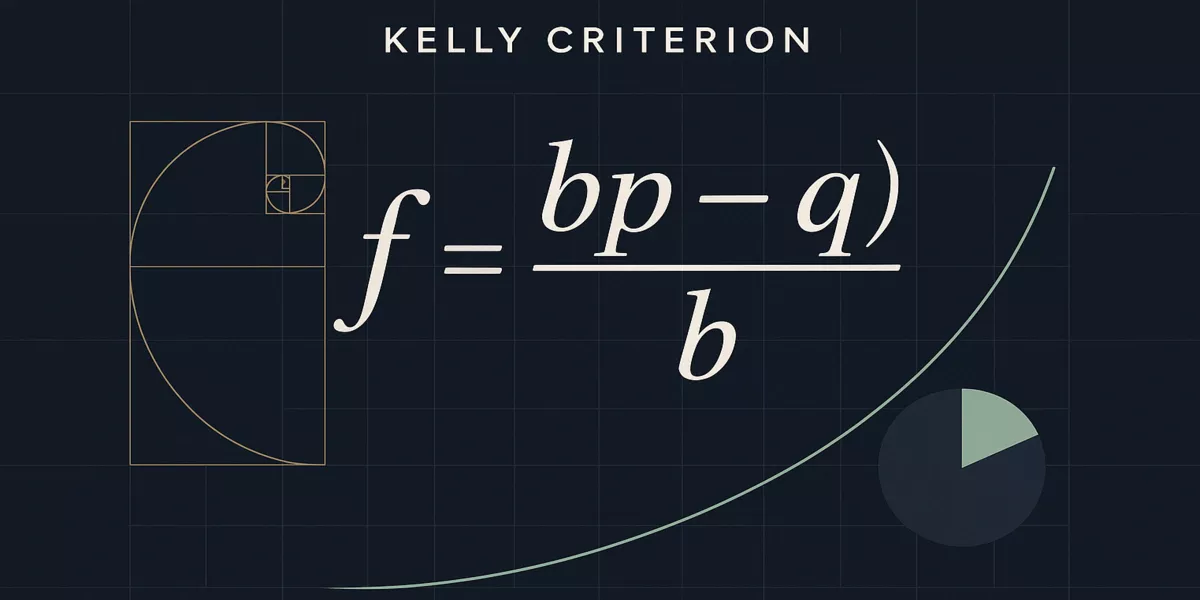
Most betting systems are essentially guesswork dressed up in mathematical clothing. Double after losses. Follow sequences. Bet more when you’re hot. These approaches ignore the fundamental question that actually matters: given my edge and the odds offered, what’s the mathematically optimal amount to bet? The Kelly Criterion is the rare betting strategy that actually answers this question with rigorous mathematics rather than hunches or emotional reasoning.
Developed by John Kelly at Bell Labs in 1956, originally for optimizing long-distance telephone signal transmission, the formula was quickly adopted by gamblers and investors who recognized its power for capital allocation. Ed Thorp famously used Kelly to beat blackjack in Las Vegas, then applied it to beat Wall Street. Professional gamblers across sports betting, poker, and financial markets use Kelly or variations thereof because it’s mathematically proven to maximize long-term bankroll growth better than any alternative staking method.
Here’s what makes Kelly genuinely different: it scales your bet size to your actual advantage. If you have massive edge on a bet, Kelly tells you to bet aggressively. If you have minimal edge, Kelly tells you to bet conservatively. No edge? Kelly says bet nothing. This dynamic scaling based on your specific advantage in each situation is what makes Kelly theoretically optimal. You’re not arbitrarily betting the same amount on everything like flat betting, and you’re definitely not chasing losses like Martingale. You’re betting exactly what mathematics says maximizes growth.
The catch and it’s substantial is that Kelly requires you to accurately estimate your probability of winning each bet. If you overestimate your edge, Kelly tells you to overbet and you suffer worse results than flat betting would deliver. If you underestimate, you underbet and grow slower than optimal. Most bettors lack the historical data and analytical rigor to estimate edges accurately, which means they misuse Kelly and get burned. This is why Kelly has a reputation as both brilliant and dangerous.
This guide explains exactly how Kelly works, walks through the mathematics without requiring advanced education, shows you how to apply it practically, and most importantly, explains when you should and absolutely shouldn’t use it. Kelly isn’t for everyone. It’s for serious bettors with proven track records who understand probability deeply. If that’s you, Kelly might transform your results. If it’s not, you’re better off with simpler approaches until you develop the necessary skills.
What is the Kelly Criterion?
The Kelly Criterion is a formula that calculates the optimal fraction of your bankroll to bet based on your perceived edge and the odds offered. The formula is elegantly simple even if the implications are complex. In its most common form for gambling: f equals bp minus q divided by b, where f is the fraction of bankroll to bet, b is the decimal odds minus one, p is your probability of winning, and q is your probability of losing which equals one minus p.
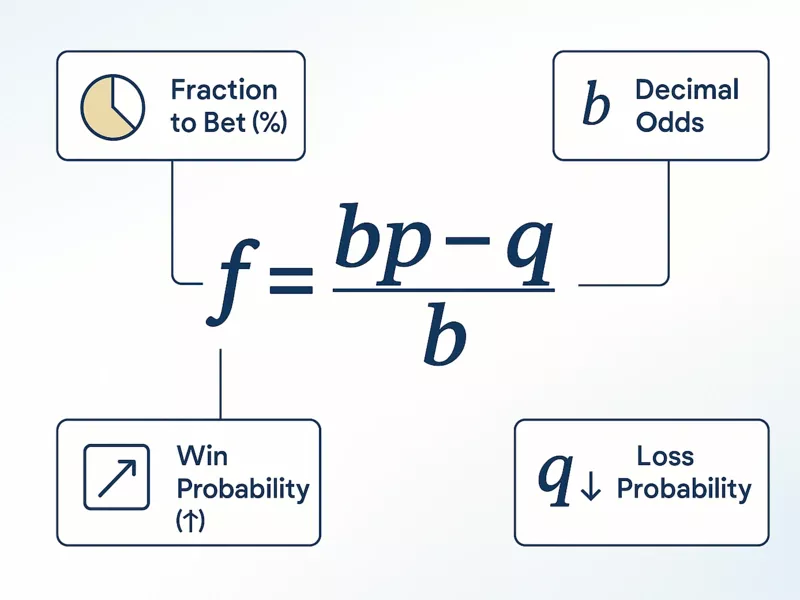
Let’s break down each component because understanding what the variables represent is crucial for proper application. The f you’re solving for is the percentage of your total bankroll that Kelly recommends betting. If f equals 0.02, you should bet two percent of your bankroll. If f equals 0.10, bet ten percent. The formula outputs this fraction directly.
The b variable represents the net odds you’re receiving, which is decimal odds minus one. If you’re betting at 2.50 decimal odds, b equals 1.50 because you’re receiving one fifty net profit per unit staked. If you’re betting at 1.90, b equals 0.90. This captures how much you win relative to your stake.
The p variable is where things get tricky it’s your estimated probability of winning the bet. Not the bookmaker’s implied probability from their odds, but your assessment of the true likelihood. If you think a team has a sixty percent chance to win, p equals 0.60. Getting this right is absolutely critical because Kelly’s output is only as good as your input.
The q variable is simply one minus p, representing your probability of losing. If you have sixty percent chance to win, you have forty percent chance to lose. The formula could be rewritten to eliminate q but keeping it explicit makes the calculation clearer.
Put it together and you get: optimal bet fraction equals (decimal odds times your win probability minus your loss probability) divided by (decimal odds minus one). If that sounds abstract, let’s work through an actual example.
You’re betting on an NFL game where the point spread is plus three at odds of 1.91 (American -110). You’ve analyzed the matchup and believe the underdog has a fifty-five percent chance to cover the spread. The bookmaker’s odds imply 52.4 percent probability (the break-even point at -110), but you think it’s actually fifty-five percent. That three percent difference is your edge.
Plugging into Kelly: b equals 0.91 (1.91 minus one). P equals 0.55. Q equals 0.45. So f equals (0.91 times 0.55 minus 0.45) divided by 0.91, which equals (0.5005 minus 0.45) divided by 0.91, equals 0.0505 divided by 0.91, equals approximately 0.055 or 5.5 percent of bankroll.
Kelly says bet 5.5 percent of your bankroll on this play. If your bankroll is one thousand dollars, that’s fifty-five dollars. Notice how the calculation naturally scales to your edge you’ve got modest three percent edge and Kelly recommends modest 5.5 percent stake. Had your edge been larger, the recommended stake would increase proportionally.
The mathematical elegance is that Kelly guarantees you’ll never lose your entire bankroll (assuming you always bet exactly Kelly amount and you’re correct about your probabilities). The formula ensures you’re betting a fraction small enough that even infinite consecutive losses couldn’t eliminate you, though they’d reduce you to infinitesimally small amounts. Meanwhile, when you win, your bankroll compounds multiplicatively rather than additively.
This compounding effect is why Kelly is theoretically optimal. It maximizes the expected logarithm of bankroll growth, which translates to reaching any specified bankroll target in minimum expected time. No other staking strategy grows bankroll faster over long run, mathematically proven. But and this is crucial that optimality requires your probability estimates to be accurate.
How to Calculate Kelly Criterion
Understanding the formula intellectually is one thing. Applying it practically requires walking through the calculation process step by step until it becomes intuitive.
Step one: Convert odds to decimal format if necessary. American odds need conversion. Positive American odds like plus 150 convert by dividing by 100 and adding one, so 2.50 decimal. Negative American odds like minus 110 convert by dividing 100 by the absolute value and adding one, so 1.909 decimal. Fractional odds convert by dividing and adding one fractional 5/2 becomes 2.50 decimal (2.5 plus 1 equals 3.50, wait that’s wrong). Actually fractional 5/2 means for every two staked you win five, so decimal is 3.50 total return. Let me clarify: fractional odds of 5/2 mean profit of 2.5 per unit, so decimal odds are 3.50 total return. The b in Kelly formula is net profit per unit, which is 2.50 for 5/2 fractional odds.
Most online bookmakers display decimal odds these days, which simplifies everything. If you see 2.50, your b is 1.50. If you see 1.91, your b is 0.91. Just subtract one from the decimal odds.
Step two: Estimate your true win probability. This is where art meets science and where most Kelly users fail. You must assess, based on all available information and your analytical models, what you believe the actual probability of winning is. This isn’t guessing it’s making informed probability assessments based on data.
Professional bettors develop models, track historical performance, account for injuries and matchup factors, and arrive at probability estimates through systematic analysis. They don’t just feel like a team has sixty percent chance they’ve calculated it based on power ratings, opponent adjustments, situational factors, and validation against past results.
For casual bettors, probability estimation is nearly impossible to do accurately. You might think you know, but you’re probably wrong. The human brain is terrible at intuitive probability. We overweight recent events, find patterns in randomness, and consistently overestimate our predictive ability. This is why Kelly is dangerous for most people.
If you’re determined to estimate probabilities anyway, at minimum track your estimates versus outcomes over hundreds of bets. If you estimate sixty percent probability on fifty bets, did roughly thirty actually win? If you’re constantly overestimating, you’re not calibrated and you’ll overbet using Kelly.
Step three: Calculate the Kelly fraction. Once you have your decimal odds and your probability estimate, plug into the formula. Let’s do several examples across different scenarios to show how Kelly scales.
Example one: You estimate 55 percent win probability on odds of 2.00 (evens). Kelly calculation: b equals 1.00, p equals 0.55, q equals 0.45. F equals (1.00 times 0.55 minus 0.45) divided by 1.00, equals 0.10 or ten percent of bankroll. This is substantial stake because you have ten percent edge (55 percent when break-even is 50 percent) at even-money odds.
Example two: You estimate 54 percent win probability on odds of 1.91 (minus 110). Kelly calculation: b equals 0.91, p equals 0.54, q equals 0.46. F equals (0.91 times 0.54 minus 0.46) divided by 0.91, equals approximately 0.033 or 3.3 percent of bankroll. Smaller stake because your edge is smaller you’re only 1.6 percent above break-even at these odds.
Example three: You estimate 52 percent win probability on odds of 1.91. Kelly calculation gives f equals approximately 0.006 or 0.6 percent of bankroll. Tiny stake because your edge is razor thin. You’re barely above break-even so Kelly says bet almost nothing.
Example four: You estimate 52.4 percent win probability on odds of 1.91 exactly break-even. Kelly calculation gives f equals zero. No edge means no bet. Kelly correctly identifies that you shouldn’t bet into zero-expectation situations.
Example five: You estimate 50 percent win probability on odds of 1.91 below break-even. Kelly calculation gives negative f. This means you should bet the opposite side or not bet at all. Negative Kelly is theoretically shorting the bet, but in practical sports betting you’d just bet the other side if available.
Notice how the Kelly stake scales beautifully to your edge. Massive edge gets aggressive stakes. Tiny edge gets conservative stakes. No edge gets no stake. This automatic scaling is Kelly’s genius you’re always betting in proportion to your advantage.
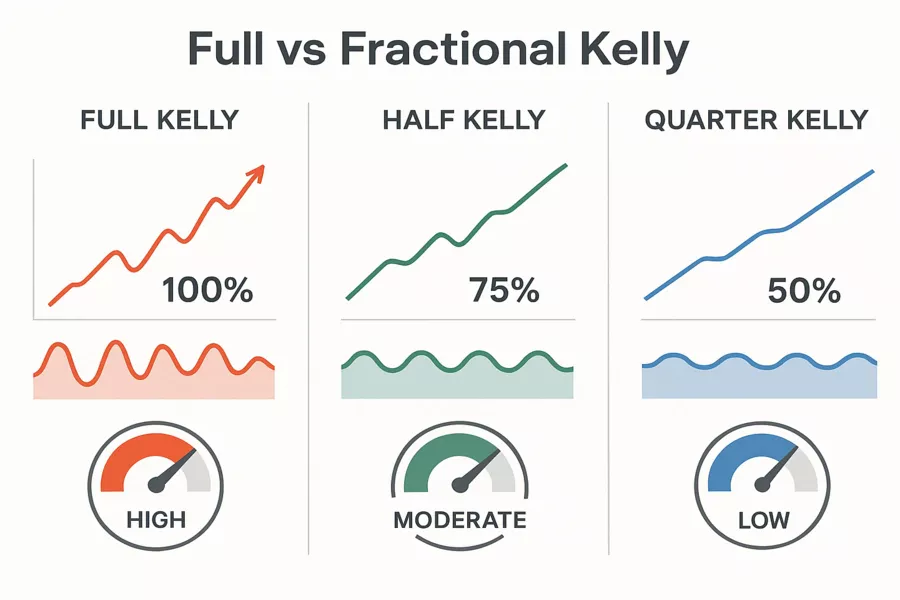
Step four: Apply fractional Kelly if desired. Full Kelly, as calculated above, maximizes growth rate but creates substantial variance. Your bankroll will swing wildly even when betting correctly because full Kelly is aggressive. Many professionals use half Kelly or quarter Kelly simply divide the Kelly fraction by two or four before betting.
Half Kelly means if Kelly says ten percent, you bet five percent. This reduces variance substantially while still growing bankroll efficiently. Quarter Kelly is even more conservative. The trade-off is slower growth, but most bettors prefer lower variance for psychological sustainability. You can maintain discipline through swings more easily when stakes are smaller.
The mathematical reality is that full Kelly maximizes growth rate, half Kelly gives you three-quarters of the growth rate but cuts variance in half, and quarter Kelly gives you half the growth rate but cuts variance by seventy-five percent. Most professionals settle on half Kelly as optimal balance between growth and stability.
Full Kelly vs Fractional Kelly
The debate between full Kelly and fractional Kelly reveals important truths about risk, variance, and psychological sustainability in gambling. Understanding the trade-offs helps you choose appropriate implementation.
Full Kelly is theoretically optimal for bankroll growth. It reaches any target bankroll in minimum expected time. The mathematics prove this conclusively no other staking strategy grows faster long-term if your probability estimates are accurate. This optimality makes full Kelly appealing to people who focus on expected value maximization.
The problem with full Kelly is variance. Even when betting perfectly with accurate probabilities, your bankroll will experience dramatic swings. Drawdowns of thirty to forty percent are normal and expected with full Kelly. You’ll have stretches where you lose significantly despite making positive expectation bets simply because variance clustering happens.
These drawdowns create psychological challenges. When you’re down thirty-five percent of your bankroll using full Kelly, maintaining discipline becomes difficult. You start questioning your probability estimates, wondering if you’ve been wrong all along. The temptation to deviate from Kelly grows. Most bettors can’t emotionally handle full Kelly variance without making mistakes that undermine the system.
There’s also the practical consideration that probability estimates are never perfect. If you’re even slightly overestimating your edge say you think you’re winning at 54 percent but really it’s 52.5 percent full Kelly has you overbetting relative to true optimal. This overconfidence compounds into worse results than more conservative approaches would deliver.
Half Kelly cuts variance substantially while maintaining most of growth benefit. If full Kelly would recommend ten percent stake, half Kelly bets five percent. Your growth rate drops to roughly seventy-five percent of full Kelly’s growth, but your variance drops to roughly fifty percent. That’s favorable trade-off for most people you grow nearly as fast but with much smoother ride.
Half Kelly also provides protection against probability estimation errors. If you’re overestimating edge, half Kelly overbets by less than full Kelly would. Your mistakes are less costly. This margin of safety is valuable for bettors who aren’t certain their probability assessments are perfectly calibrated.
The psychological sustainability of half Kelly is its strongest argument. Drawdowns are smaller, typically staying under twenty percent. This is emotionally manageable for most people. You can maintain discipline through variance more easily, which means you actually execute the system consistently rather than abandoning it during tough stretches.
Quarter Kelly is extremely conservative, basically halfway between Kelly and flat betting in terms of aggression. If Kelly suggests ten percent, quarter Kelly bets 2.5 percent. Growth rate drops to roughly fifty percent of full Kelly, but variance becomes minimal. Your bankroll fluctuations will be modest and manageable.
Quarter Kelly makes sense for bettors who have genuine edge but are uncertain about probability calibration or who have low risk tolerance. You’re still betting proportionally to advantage, which is better than flat betting’s uniform approach, but you’re doing so cautiously. The cost is slower growth, but the benefit is sustainability.
The decision between full, half, and quarter Kelly ultimately depends on several factors. How confident are you in your probability estimates? Do you have extensive historical data showing your estimates are well-calibrated? If yes, you can justify more aggressive Kelly fractions. If no, be conservative.
What’s your risk tolerance and psychological resilience? Can you handle seeing your bankroll drop thirty percent over a month without panicking or deviating from strategy? If yes, perhaps full Kelly works. If no, fractional Kelly is smarter because a system you can execute imperfectly beats an optimal system you abandon halfway through.
How large is your edge and how often do you bet? If you’re making hundreds of bets per month with consistent edge, growth compounds quickly even at conservative fractions. You don’t need full Kelly’s aggression to grow meaningfully. If you’re making occasional bets with sporadic edge, maybe you want more aggressive growth when opportunities arise.
Most professional sports bettors seem to settle on half Kelly or somewhere between half and quarter Kelly as practical optimum. They value the psychological sustainability and protection against estimation errors more than the theoretical maximum growth of full Kelly. The pros understand that actual implementation matters more than theoretical perfection.
The Challenge of Accurate Probabilities
Kelly Criterion’s Achilles heel is its dependence on accurate probability estimation. The formula is only as good as your inputs, and most bettors drastically overestimate their ability to assess true probabilities. This section confronts that reality directly.
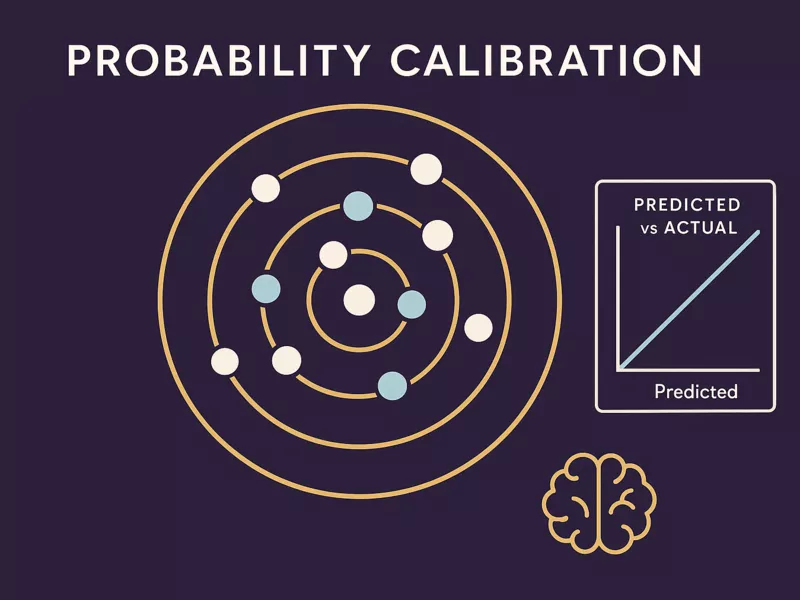
The calibration problem is that humans are naturally overconfident. When you say a team has sixty percent chance to win, do you mean you’ve analyzed the situation so thoroughly that if you made one hundred similar assessments, almost exactly sixty would be correct? Or do you mean it feels like they’ll probably win? These are very different things, and most people mean the latter while Kelly requires the former.
Most bettors never do this calibration work. They estimate probabilities intuitively based on feelings and analysis, then plug those numbers into Kelly and wonder why results disappoint. The formula doesn’t fail their inputs fail. Garbage in, garbage out. Kelly punishes inaccurate probability assessment more severely than flat betting would because Kelly’s aggressive scaling magnifies errors.
Building probability models properly requires systematic methodology. Professional bettors develop power rating systems, create opponent-adjusted efficiency metrics, factor in situational variables, and validate their models against historical out-of-sample data. They’re not guessing they’re calculating probabilities from models proven to have predictive power.
Building such models requires significant time, analytical skill, and historical data. Most casual bettors lack these resources. This isn’t meant to discourage it’s meant to clarify that Kelly works brilliantly for people with sophisticated analytical frameworks but fails for people betting on hunches regardless of how smart those hunches feel.
Using closing line value provides an alternative probability estimation method. The closing line the odds available right before game start is considered the most efficient price because it incorporates all information and betting market wisdom. If you consistently bet better prices than the closing line, you have demonstrable edge even if you can’t calculate exact win probabilities.
This approach grounds Kelly in actual market feedback rather than subjective assessment. You’re not claiming to know true probabilities you’re claiming to beat closing lines consistently, which is objectively measurable. If your CLV is positive over meaningful samples, you have legitimate edge and Kelly is appropriate. If CLV is negative or neutral, you don’t have edge and Kelly says don’t bet.
The overconfidence tax is what you pay when using Kelly with inflated probability estimates. If you think you win at 56 percent but really you win at 53 percent, Kelly has you betting roughly twice what’s actually optimal. This overexposure means you experience much higher variance than necessary and potentially worse returns than flat betting would deliver.
The brutal reality is that developing accurate probability estimation skill takes years of dedicated work. You need to track thousands of bets, constantly refine your models, admit when you’re wrong, and update your methods based on outcomes. Most people aren’t willing to do this work, which means most people shouldn’t use Kelly.
Kelly Criterion in Practice
Moving from theory to application requires addressing practical considerations that determine whether Kelly actually works in real-world betting.
Software and calculators make Kelly implementation easier but don’t solve the probability estimation problem. Many websites offer Kelly calculators where you input your perceived edge and odds and receive a recommended stake. These tools are fine for arithmetic but they’re useless if your edge estimates are wrong.
More sophisticated bettors build spreadsheets that track all bets with Kelly recommendations, actual stakes, outcomes, and performance metrics. This allows review of whether your Kelly implementation is working. If you’re consistently betting Kelly amounts and losing money, either your probability estimates are wrong or you’re getting unlucky. Extended samples reveal which.
Portfolio Kelly addresses the challenge of multiple simultaneous bets. Standard Kelly assumes one bet at a time, but sports bettors often have multiple plays overlapping. If you have three Kelly recommendations all saying bet five percent, should you bet fifteen percent total? That seems like massive overexposure.
The practical implementation most bettors use is simpler: they set maximum total exposure limits. Maybe no more than twenty percent of bankroll active across all bets at once, regardless of individual Kelly recommendations. This caps total risk during periods when Kelly suggests many simultaneous plays.
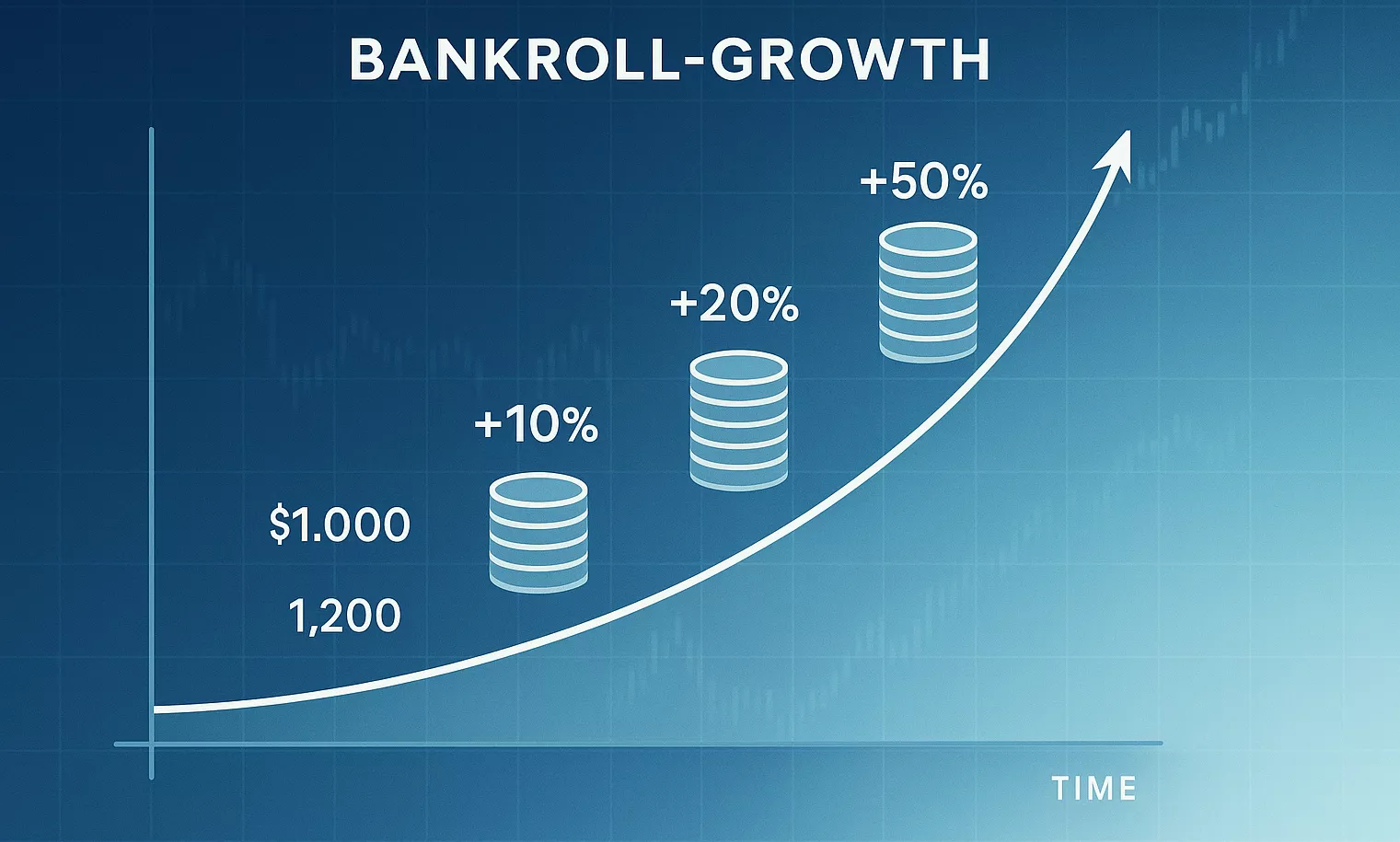
Dynamic bankroll adjustments are essential because Kelly naturally scales as bankroll changes. If you start at one thousand dollars and grow to twelve hundred, your Kelly stakes should increase proportionally. Conversely, if you drop to eight hundred, stakes should decrease. This ensures you’re always betting appropriate percentages relative to current bankroll rather than original bankroll.
Most professionals recalculate bankroll daily and adjust unit sizes accordingly. This sounds tedious but it’s necessary for proper Kelly implementation. You can’t just set stakes once and forget Kelly requires constant adjustment to current bankroll levels. This is another reason flat betting appeals to casual bettors; it’s operationally simpler.
Psychological discipline remains the make-or-break factor. Kelly tells you what to bet mathematically, but you still have to actually place those bets emotionally. When Kelly says bet eight percent of your bankroll on a play, can you pull the trigger confidently? When you’re down twenty percent on the month, can you maintain Kelly stakes rather than betting scared?
Many bettors discover they can’t. They intellectually understand Kelly but emotionally they deviate during tough stretches. This undermines everything. Better to use a suboptimal system you can execute consistently than an optimal system you abandon halfway through. Know yourself before committing to Kelly.
Pros and Cons
Let’s evaluate Kelly honestly, weighing genuine advantages against significant limitations.
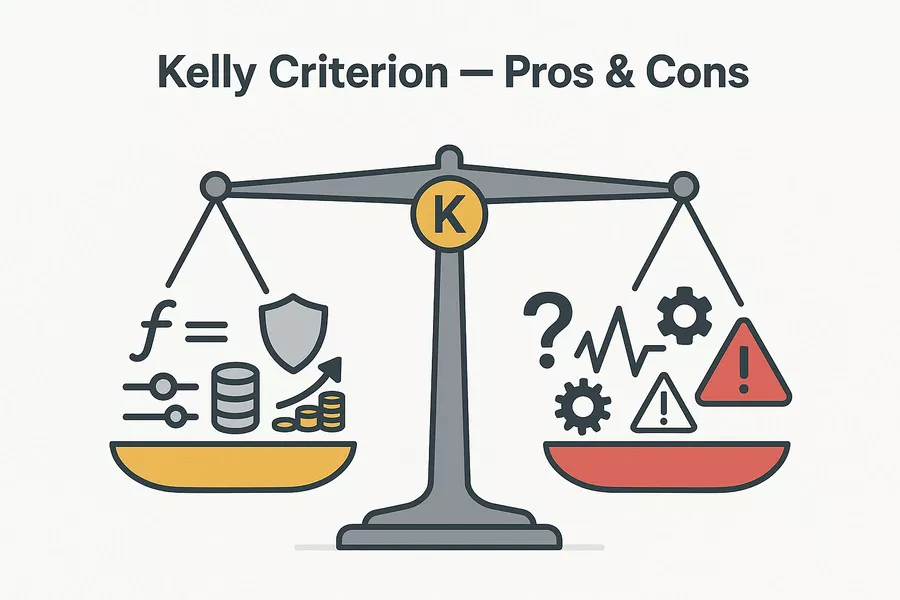
Advantages start with mathematical optimality. Kelly provably maximizes bankroll growth rate better than any alternative if your probability estimates are accurate. This isn’t opinion it’s mathematical fact proven by Kelly’s original work and subsequent information theory research. For bettors with genuine edge and accurate probability assessment, Kelly is unambiguously the best staking method.
Automatic scaling to edge is Kelly’s elegant feature. You don’t bet the same on everything or follow arbitrary progressions. You bet in direct proportion to your advantage on each specific play. Big edge gets big bet. Small edge gets small bet. This optimal capital allocation ensures you’re extracting maximum value from your edge whenever it appears.
Protection against ruin is built into the formula. Kelly never recommends betting so much that you could lose everything. Even infinite consecutive losses couldn’t eliminate your bankroll if you bet exactly Kelly amounts. Practically, you’d be reduced to tiny amounts and effectively eliminated, but theoretically Kelly protects against true ruin.
Compound growth happens naturally with Kelly. Because you’re increasing stakes as bankroll grows, your profits compound multiplicatively. A thousand-dollar bankroll with ten percent monthly edge grows faster under Kelly than under flat betting because Kelly automatically scales bets up as you profit. This compounding accelerates wealth accumulation dramatically over time.
Now the disadvantages, which are substantial and often underappreciated.
Requires accurate probability estimation and most bettors can’t do this. This is Kelly’s fatal flaw for casual use. The formula assumes you know your true win probability with precision. In reality, you’re guessing with varying degrees of sophistication. Poor guesses lead to poor results often worse than flat betting would produce. Unless you’ve proven probability calibration over hundreds of bets, Kelly is dangerous.
High variance even when betting correctly means dramatic bankroll swings. Full Kelly can see drawdowns of thirty to forty percent despite making exclusively positive EV bets. This variance is psychologically brutal. Most people can’t maintain discipline through these swings without deviating from strategy, which undermines the entire system.
Complexity of implementation compared to flat betting creates friction and error opportunities. You must track bankroll continuously, recalculate stakes for each bet based on current bankroll and perceived edge, adjust for correlations across multiple bets, and maintain probability estimation discipline. This operational complexity means more things can go wrong.
Overconfidence magnification turns small estimation errors into large staking errors. If you think you have five percent edge but really have three percent, Kelly has you overbetting significantly. Because stakes scale to perceived edge, overconfidence in your abilities translates directly to overexposure. Flat betting doesn’t have this property you bet your unit regardless of perceived edge.
Unsuitability for recreational bettors is perhaps the most important limitation. Kelly is for serious professionals with proven track records, sophisticated models, and extensive historical data. If you’re betting for entertainment or casually following sports, Kelly is overkill and probably harmful. The precision it requires doesn’t match recreational betting contexts.
Kelly isn’t for beginners. It’s not for casual bettors. It’s not for people who bet on hunches no matter how educated those hunches are. Kelly is for the small percentage of serious bettors who’ve graduated beyond amateur status into professional or semi-professional operation. If you’re reading this and wondering whether you qualify, you probably don’t yet but aspiring to reach that level where Kelly makes sense is a worthy goal that requires years of dedicated work developing the underlying skills Kelly demands.
See also: betsystemexpert – master every betting system.
See also: Flat Betting Strategy – the simplest and safest staking method.
